Responding to Interview Questions
“Tell me about yourself.” “What are some of your weaknesses?” These “easy” job interview questions give an employer a chance to evaluate a candidate’s social, communication, and problem solving skills. Candidates must choose what information to share, being careful to portray themselves in a positive light while keeping the information relevant to the job. They must also remember to be polite and use relaxed body language. This can be far from relaxing for anyone! When preparing a student for job interviews, the instructor must evaluate the student’s strengths and challenges and prioritize the many skills that should be practiced. In this way, the student can, over time, learn to analyze the intent of the interviewer’s questions, formulate appropriate responses, and deliver them in a professional and confident way.

Teaching Ideas
Click on the icons below for detailed information on how to teach this skill.





 Guiding Questions
- Are the student’s verbal responses limited by difficulty processing verbal information or questions?
- Does he recognize when the speaker is asking him a question? For the higher-level student, can he learn to identify the underlying intent of the question?
- What repair strategies does the student use during communication? Can he ask for clarification when he does not understand what is said or meant? Can he ask for a moment to think about the question?
- Can he read the body cues and voice cues of the speaker while processing the verbal information?
- Can he generate a response that adequately and appropriately answers the question?
- Does he struggle to use appropriate non-verbal behaviors (e.g. facial expressions, body positioning, limited fidgeting) as he responds to questions?
- Does the student possess the self-regulation skills necessary to avoid monopolizing or “monologuing” in his response?
- Does the student possess the self-regulation skills necessary to avoid interrupting the speaker?
Visual Supports

Communication systems and scripts provide the student with a means to initiate communication. Use these cards to practice different scenarios with your students.
|
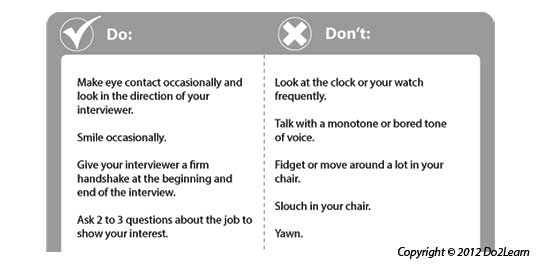
Graphic organizers can provide a student with a way to represent and organize concepts, thoughts, feelings, behaviors, and potential outcomes.
|
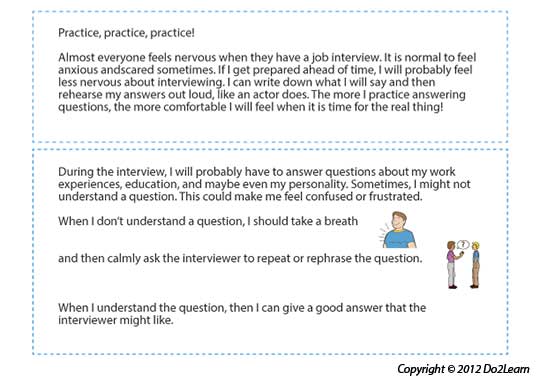
Social narratives are a set of tools that visually represent social situations and appropriate social behaviors. The social narrative connects the important details of a setting or social situation to support the student in understanding the social context and in developing a new social skill.
|
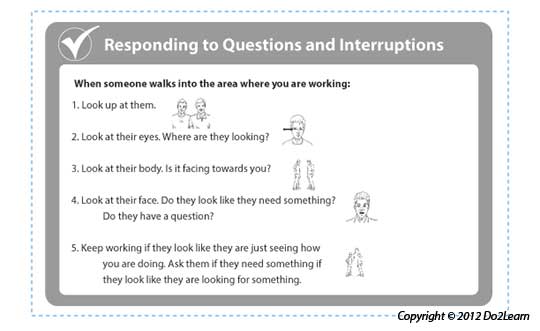
Visual Cues are learning materials that students can keep with them to help guide them through real life situations.
|
|
Video modeling involves the use of video recording as a teaching tool. It involves a student watching a video of the appropriate performance of a task (expected behavior) prior to practicing or potentially using the skill in natural settings.
|
Does the design of space and furniture help the student focus on the tasks and behaviors expected in the setting?
Carefully consider how you arrange the environment in role-play simulations to most closely approximate what the student would encounter when he is in an actual interview. Use props to represent items that might be found on an interviewer’s desk when the interview is likely to take place in some form of office setting. Incorporate those props to assess how the student responds to them – Does he fidget with those items? Is he visually distracted by those items? Also consider that some interviews might occur in less traditional contexts (e.g. in a restaurant booth). Work to prepare the student for any environmental demands to which he might be sensitive.
|