

- Disabilities
- Overview
- Definitions
- Evaluation & Identification
- Characteristics & Strategies
- Parents and Teachers
- Academics
- Behavior Management
- Picture Cards
- JobTIPS Student
- Products
Brief Report: Two Case Studies Using Virtual Reality as a Learning Tool for Autistic ChildrenReprinted with permission from the Journal of Autism and Developmental Disorders, Vol. 26, No. 6, 1996.Dorothy Strickland , North Carolina State University 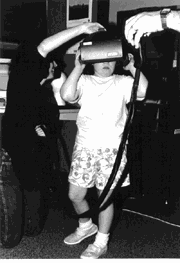
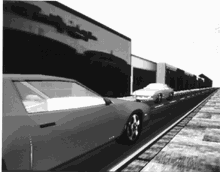
INTRODUCTIONIn 1895 the Lumieres' documentary Train Entering Station reputedly made audiences flee or duck for cover, fearful for their lives (Pirie, 1981). Film is now widely recognized as a technology capable of making the human body respond emotionally, as when adrenaline increases at a horror movie. Virtual reality carries the fantasy a step further, immersing the user in an illusion which responds as the real world does. The human interaction with the imaginary world is not conducted through watching other peoples' motions but by controlling the new reality through one's own actions. For this reason virtual reality (VR) allows individuals to explore new ways of responding and learning. Definition of Virtual Reality There are several levels of VR, the most sophisticated of which is called immersion. In this version the user wears a headset containing two small video screens, one suspended in front of each eye. As the person moves, the movement is tracked and used to reposition the user's location in the scene. Previous Applications Why Consider VR for Autism? Sensory Problems. Many children with autism have difficulty with multiple sources of sensory input (Grandin & Acariano, 1996). Stimulation in certain settings can be overpowering, causing difficulties and behavior deterioration. VR isolates specific stimuli from the environment and allows subjects to control how much they will experience. Complex stimulus arrays can be simplified. Lack of Generalization. Difficulty generalizing behaviors learned in a single setting to similar appropriate situations has frustrated treatment efforts in autism. What is taught in one situation does not necessarily occur naturally in related appropriate situations. VR makes generalization easier because of the realism that it brings to treatment situations. Visual Thought Patterns . Many have observed that thinking in people with autism is primarily visual (Grandin, 1992; Schopler, 1987). Intervention techniques have been successful when they capitalize on these visual strengths (Mesibov, Schopler, & Hearsey, 1994). VR, emphasizing visual skills, seems to be an appropriate modality for people with autism and should give them an excellent opportunity for learning new concepts and behaviors. Individualized Treatment. Although there are general characteristics that all people with autism share, effective approaches must individualize their techniques to meet the needs of individual clients (Schopler, Mesibov, & Hearsey, 1995). Computerized instruction using VR allows for constant readjustments, based on the needs and skills of individual clients. Learning imagery can be readjusted to compensate for individual styles and changing patterns. Responsiveness with Computer Technology. Although computers have not been adapted by special education programs as quickly as some would like, there is increasing evidence that they represent an effective new approach to education and learning for children with developmental disabilities (Howard, Buch, Watson, & Shade, 1991). Given the characteristics of autism and the encouraging preliminary data, it appears reasonable to expand the use of computerized instruction for individuals with autism and VR is a promising avenue for this extension. DESIGN OF STUDYThis study was designed to determine if children with autism would tolerate VR equipment and respond to the computer-generated world in a meaningful way. Project Team Subjects S. is a 71/2 year-old girl with very strong visual spatial skills, limited verbal and language based abstract reasoning skills. Recent cognitive testing resulted in an IQ of 91 on the Leiter International Performance Scale. She was able to do one subtest of the WPPSI-R with good success (Object Assembly), but was unable to complete other performance tests. On the CARS (Schopler et. Al., 1988), she was classified as Mild to Moderately Autistic with a score of 36.5. R. is a 9-year-old boy with somewhat better language skills, but also considered a visual learner. Cognitive testing resulted in an IQ of 62 on the Merril Palmer Scale of Mental Tests. He was able to do relatively well of the Object Assembly test of the WPSSI-R, but unable to complete other tests on this scale. On the CARS, he was classified as Mild to Moderate Autistic with a score of 34.0. The interactive controls standard with most VR were difficult for the children to use. Pointing also would not work because the computer cannot track the hand motion unless it has a tracking device affixed, and it is disconcerting to point at something in front of your face and not see your arm and hand. Because both children had some language skills, we primarily used simple verbal responses such as "car," "red," "blue," and walking motion to indicate response to the world. Design of Sessions Physical Layout and Schedule Schedules were used to explain which activities would occur and in what sequence they would occur to help the children anticipate and predict events. Each child had a basic routine of work first and then play with the VR test between. In later tests the play period was dropped. Preliminary Helmet Acceptance Efforts RESULTS AND DISCUSSIONS. and R. came in separately for approximately 30-minute to 1-hour sessions. During that time both children repeated the work, helmet, play cycle multiple times. S. had twenty-one 3- to 5-minute sessions over a 7-day period, and R. had sessions of shorter duration over a 4-day period. The goal was to teach the children to accept the helmet and pay attention to the images. We initially asked each child to identify cars when they appeared and say the car color if possible. On the first attempt, both children accepted the helmet and immersed themselves in the scenes. We started the children sitting in a swivel chair. S. immediately followed the cars visually and identified the colors correctly. At one point she said "ca" when a car turned a corner. In the first session S. stayed the full 5-minute maximum before the helmet was removed. R. would not wear the helmet as long initially. He appeared more concerned with understanding where the images were coming from. R. would look at the in the helmet and then lift it up and look at the same scene of the flat screen. Several times he tried to look in the front of the helmet from the outside as if trying to find the images. We finally removed the flat screen from his range of vision and R. immersed himself in the helmet for longer periods. R. then followed the cars with his eyes for short times and correctly identified the cars and their colors when asked. The number, color and speed of the cars were modified repeatedly and the children were placed in three different street scenes. Once it became obvious they needed a more difficult task in the virtual world, we tried a variety if experiments to measure the children's reaction to changes in the VR task. We asked both children to walk in the virtual world. We also asked each child to locate a movable stop sign in the scene and walk toward it. The results of these trials indicated: Additional individual results were as follows: The difference between these two children's ability to walk toward the sign appeared to be related to their understanding of the VR image as an interactive three-dimensional world. Although S. freely walked to the sign to receive a reward, R., when told to "go to sign," would point to the sign inside the helmet. R. appeared to respond to the image as though it were on a typical flat computer screen . S. appeared to understand that her motions were translated into motions in the virtual world. SUMMARYThe children complied with most requests. Some of our teaching goals were limited by technology or space, while others were limited by the difficulty of presenting a task to the children in a way that was understandable within their environment. However, the opportunity to introduce this technology to children was an important first step in exploring the potential VR offers to understanding the perceptual processes involved in autism. Our results indicate that the children will accept a VR helmet and wear it, identify familiar objects in their environment while using the helmet, and locate and move toward objects in their environment while wearing the helmet. More research is necessary to verify the potential in this area, especially to discover if learning experiences through VR generalize to other environments, but it appears virtual reality may provide a useful tool for furthering our understanding of autism and guiding efforts at treatment and intervention. REFERENCESBrown, D., Cobb, S., & Eastgate, R. (1993). Close encounters, study at Nottingham University. Special Children, 68, 31-33 Grandin, T. (1992). An inside view of autism. In E. Schopler & G. B. Mesibov (Eds. in.), High-functioning individuals with autism (pp. 105-126). New York: Plenum Press. Grandin, T., & Acariano, M. (1986). Emergence: Labeled autistic. Novata, CA.: Arena. Gregory, R. L. (1991). Seeing by exploring. In S.R. Ellis (Ed.), Pictorial communications in virtual and real environments (pp. 328-337). London: Taylor & Fancil. Howard, JR., Busch, J.C., Watson, T. A., &Shade, D. D. (1991). The change-over to computer-based technology in early childhood special education. Journal of Research on Computing in Education, 23, 530-544. Kuhn, L. (1994). The virtual wheelchair: Overcoming real-world obstacles with cyberspace technology. Second Annual International Conference on Virtual Reality and Persons with Disabilities. Sponsored by IEEE and Center on Disabilities at California State University, San Francisco. Mesibov, G. B., Schopler, E. & Hearsey, K. A. (1994). Structured Teaching. In E. Schopler & G. B. Mesibov (Eds.). Behavioral issues in autism (pp. 195-206). New York: Plenum Press. Mowafy, L. (1994). Unpublished report. University of Dayton Research institute and Armstrong Lab, Mesa, Phoenix. Pirie, D. (1981). Anatomy of the movies. New York, Macmillan. Powell, G., & McJunkin, T. (1994). Autonomous wheel chair control by an approximate virtual reality system. Second Annual International Conference on Virtual Reality and Persons with Disabilities, San Francisco. Pyne , F. (1994). Claustrophobia study. Unpublished report, Psychology Dept., University of North Carolina at Chapel Hill. Rothbaum, B., Hodges, L., Kooper, R., Opdyke, D., Williford, J., & Northe, M. M. (1995). Effectiveness of computer-generated (virtual reality) graded exposure in the treatment of acrophobia. American Journal of Psychiatry, 52, 626-628. Schopler, E. (1987). Specific and nonspecific treatment factors in the effectiveness of a treatment system American Psychologist, 42, 379-383. Schopler, E., Mesibov, G. B., & Hearsey, K. (1995). Structured teaching in the TEACCH system. In E. Schopler & G. B. Mesibov (Eds.). Learning and cognition in autism (pp. 2243-268). New York: Plenum Press. Schopler, E., Reichler, R. J., & Renner, B. R. (1988). The Childhood Autism Rating Scale. Los Angeles: Western Psychological Services. Swan, J. E., & Stredney, D. (1994). The determination of wheelchair user proficiency and environmental accessibility through virtual simulation. Second Annual International Conference on Virtual Reality and Persons with Disabilities, San Francisco. Wilson, P. (1993). Nearly there, study at Leicester University. Special Children, 68, 29-30. |
 VR
Equipment and World
VR
Equipment and World 