Does the design of space and furniture help the student focus on the tasks and behaviors expected in the setting?
Employers are often very responsive to our efforts to adapt the environment to improve work performance. If you can see how to adjust where a task is done, if you can see how to move furniture to reduce distractions, if you can see how to organize materials to reduce transition distance and increase worker speed, you are the employer’s best friend. If moving a work station or adding a partition in a key spot will improve speed and quality, there is a good chance that discussion with the employer or supervisor about such adjustments will be met with a willingness to adapt.
Does the environmental design address student issues with proximity to others or even distractibility that may reduce performance (working close to others may set up too much interaction)?
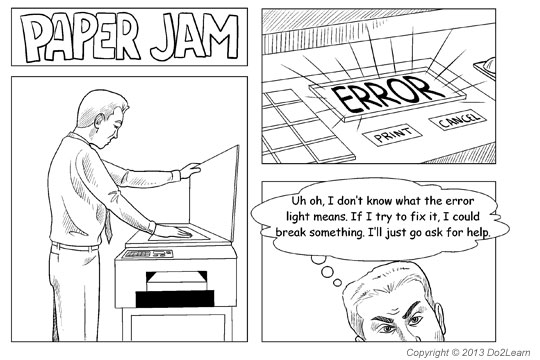
In many offices, copy machines, scanner/fax machines, postage machines, etc. are in a common area and may be close to office mail boxes. Consider how you might, with the support of the supervisor, segment the space to support the student’s focus (and others’ focus for that matter). Will the rotation of a work table by 90 degrees create separate space and reduce the likelihood of distracting physical proximity? If available, partitions can serve to segment space and reduce distractions.
The copy machine may be in a high traffic area that may lead to interruptions or distraction. There may be a way to partition or separate the ‘copying’ space from other office functions and responsibilities. You can work with the supervisor to create an individual work station in close proximity to the equipment the student will use.
It may be important to limit the number of interactions with customers by adapting environmental design to reduce likelihood of interaction
Is the space designed to support independent movement both within and between tasks?
Look carefully at the distance between spaces in a work site. If materials for a task are in two separate areas, these may be reorganized for ease of access and closer proximity to where the work is completed. You may be able to adjust the places where work is done so that the student moves quickly between and within activities. Employers respond positively to suggestions of arrangement that will make workers more efficient.
Are there clear separate spaces for different contexts or sets of activities (i.e., place to take a break vs. work spaces vs. place for belongings, etc.)?
Most employment settings have a separate break and/or lunch area. Having separate spaces for work and for break, for belongings and for lunch, will help in defining what the student does in each space.







 Guiding Questions