Grooming And Dressing
Employers expect their workers to arrive each day for work neatly groomed and dressed appropriately for the job. Job applicants must make a good first impression by showing careful attention to hygiene and dressing. Having consistently good standards of personal appearance requires planning and the social skills to know what is acceptable in terms of clothing, grooming, and hairstyles. Teaching students these social norms, such as brushing teeth and hair each day and wearing freshly-laundered clothes, and helping them develop strategies to meet these norms, will help them make a good impression on employers. They can then arrive at work confident in their neat, professional appearance.
Teaching Ideas
Click on the icons below for detailed information on how to teach this skill.





 Guiding Questions
- How is the student’s personal hygiene? Is their hair neat? Teeth brushed? Are they regularly bathing and wearing deodorant?
- Does the student understand basic rules about their attire? Are there no rips, holes, or stains in their clothes? Do their clothes match (at least somewhat)?
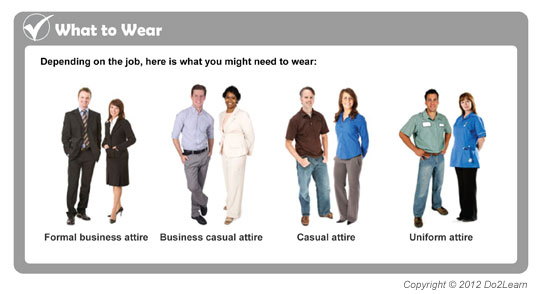
- What type of attire is appropriate for the kinds of jobs the student is applying for?
- Does the student know how to maintain appropriate hygiene but simply forgets steps along the way? (Knows to wear deoderant, but forgets to do so regularly.)
- Does the student have the organizational skills to complete dressing and grooming routines independently within a set period of time?
- What family or in-home supports will assist with this goal?
Visual Supports
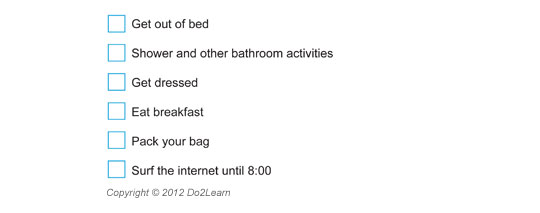
Schedules are visual supports that organize the school or work day and tell the student where he will go that day. Schedules help focus attention on the sequence of places and events.
|
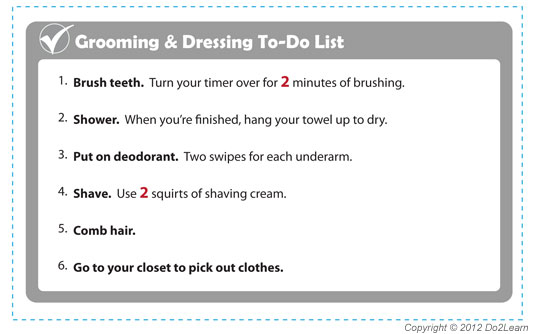
The to-do list (also referred to as a "work system"or "activity system") visually clarifies a series of activities that a student is to do.
|
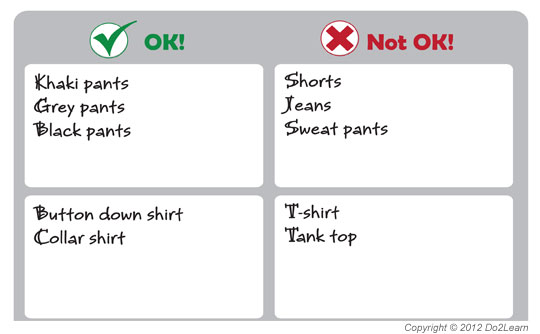
Graphic organizers can provide a student with a way to represent and organize concepts, thoughts, feelings, behaviors, and potential outcomes.
|
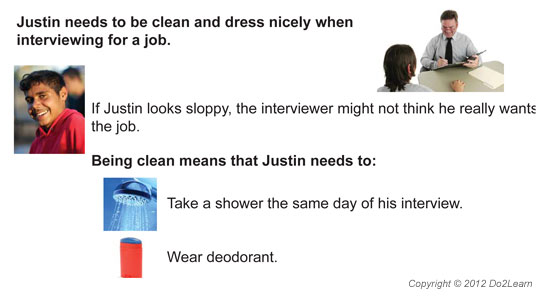
Social narratives are a set of tools that visually represent social situations and appropriate social behaviors. The social narrative connects the important details of a setting or social situation to support the student in understanding the social context and in developing a new social skill.
|
Visual Cues are learning materials that students can keep with them to help guide them through real life situations.
|
Does the design of space and furniture help the student focus on the tasks and behaviors expected in the setting?
Often, if the student agrees, review of how the environment is designed to assist student focus is critical. If work clothes are organized in one section of the closet, does this assist dressing? If all grooming materials are in a basket or one drawer in the vanity or bathroom does this also assist focus? This simple adjustment can be very powerful.
Is the space designed to support independent movement both within and between tasks?
How can the caregiver/instructor keep all materials necessary for one routine within a limited space to assist speed and transition during the routine? How can direct instruction and repeated practice lead to the student arranging his own materials in this way?
|