
Working as part of a team is necessary in both the classroom and in the workplace. Co-workers want to work with people who are easy to get along with, who share the work fairly, and who get their part of the work done reliably. Being a good team player requires advanced social skills. Each part of the team must work together to divide up the tasks, form a plan and a schedule, share expertise and ideas, and monitor the group’s progress. Team members must also be able to resolve conflicts efficiently, before little disagreements become major roadblocks. Instructors should help students identify the qualities of a good team member and develop strategies to address the many social interactions that arise when working in a group. Employers appreciate workers who can work well in a group, so advancing these skills will help to make a stronger and more effective employee.

Click on the icons below for detailed information on how to teach this skill.





 Guiding Questions
- What are the student’s strategies, personal supports and visual supports that help him manage his independent work responsibilities? *If this is unclear, address appropriate Task Completion topics. Review the topic(s) to determine how to provide full and systematic support in group projects.
- Which of those Task Completion strategies and structures can be used or adapted to support completion of one’s responsibilities in a group project/task?
- Does the student need to focus on and practice a plan for negotiation of responsibilities?
- Does the student need to focus on and practice a plan for periodic monitoring of task progress?
- Does the student need to focus on and practice a plan of identifying a problem, addressing with co-worker(s) and then seeking supervisor assistance as needed?
- How can you combine these plans to create one complete strategy for working with co-workers?
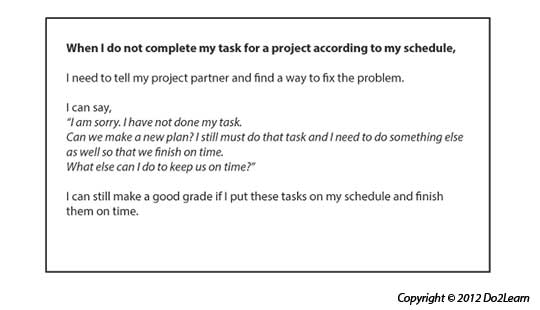
 Communication systems and scripts provide the student with a means to initiate communication. Use these cards to practice different scenarios with your students.
|
 Schedules are visual supports that organize the school or work day and tell the student where he will go that day. Schedules help focus attention on the sequence of places and events.
|
 The to-do list (also referred to as a “work system“or “activity system“) visually clarifies a series of activities that a student is to do.
|
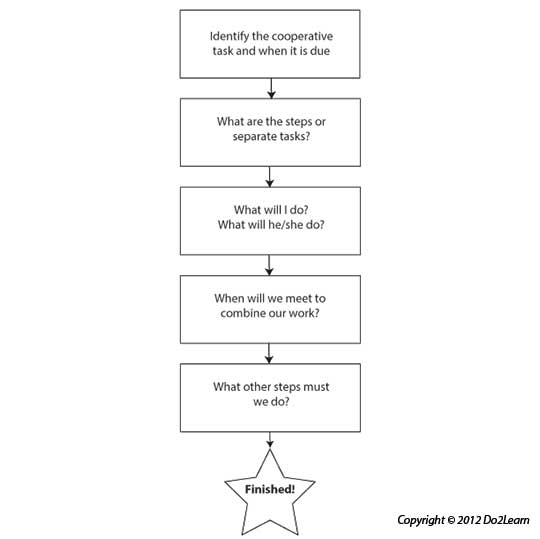
 Graphic organizers can provide a student with a way to represent and organize concepts, thoughts, feelings, behaviors, and potential outcomes.
|
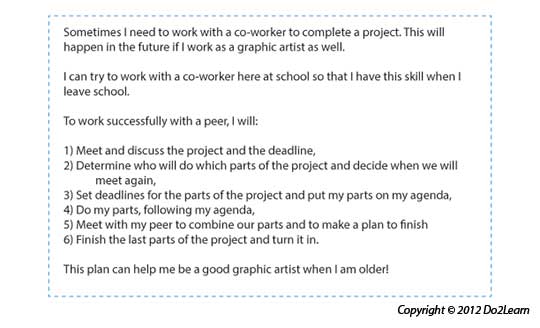
 Social narratives are a set of tools that visually represent social situations and appropriate social behaviors. The social narrative connects the important details of a setting or social situation to support the student in understanding the social context and in developing a new social skill.
|
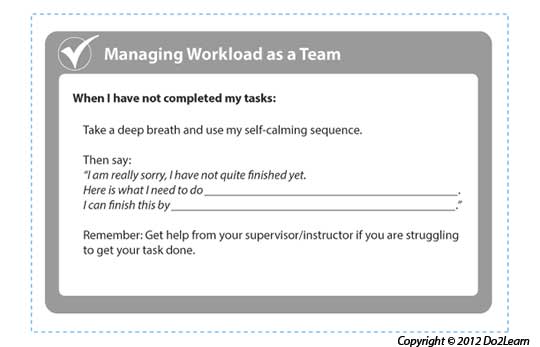
 Visual Cues are learning materials that students can keep with them to help guide them through real life situations.
|
 Video modeling involves the use of video recording as a teaching tool. It involves a student watching a video of the appropriate performance of a task (expected behavior) prior to practicing or potentially using the skill in natural settings.
|
 Does the design of space and furniture help the student focus on the tasks and behaviors expected in the setting? Initially, in the use of a collaborative plan or a problem solving process, providing practice in a low-stimulation area is probably appropriate. Is the initial setting for practice relatively quiet? Have you reduced external stimulation to help the student focus? In other words, avoid initial practice in the cafeteria! Create an environment that is conducive to focus on the visual support and to the peer. Does the environmental design address student issues with proximity to others or even distractibility that may reduce performance (working close to others may set up too much interaction)? Working with a peer can create multiple stimulation issues for some. Is sitting too close over-stimulating or confusing? If there are others in the immediate space, this can distract and confuse the student. When beginning the use of a plan or of a problem solving process, it may be best to have the two students sitting across from each other at a table. Do you position yourself in a way that the target student sees as supportive but not confrontational? |
