Beginning & End of the Interview
The first few moments of a job interview set the stage for the entire interview, and the last few moments provide a lasting impression for the interviewer. Shaking hands, having a pleasant facial expression, and participating in “small talk” are all expected at the beginning of an interview. Knowing when and how to initiate and participate in these pleasantries may feel stressful for some job applicants, so it is important to practice those crucial first moments of an interview before the big event. Working through these practice interviews can help a job applicant make a great first impression and wrap up the interview in a positive way.

Teaching Ideas
Click on the icons below for detailed information on how to teach this skill.





 Guiding Questions
- Does this student initiate greetings and/or farewells appropriate to the recipient (e.g. “Hey” to peer versus “Hello, how are you?” to interviewer)?
- Will the student respond to a handshake initiation? Will the student initiate a handshake during the greeting or goodbye?
- Does this student display discomfort/awkwardness during the greeting or farewell?
- Is the student’s reciprocal greeting or farewell “proportional” to the counterpart’s? For example, when the counterpart says “It was nice to meet you today,” the student reciprocates with “It was so nice to meet you, too” (instead of saying “yeah”).
- Does this student display appropriate body language, facial expressions, eye contact approximations, and physical proximity during greetings and goodbyes?
- With regards to performance during “small talk” exchanges, can the student appropriately elaborate on what others say to maintain a topic? (“Wow it is hot outside today” – “Yes, it really is. It feels nice and cool in here though.”). Can the student adjust to topic transitions initiated by others? Consider the relevance of this when an interviewer is ready to switch from “small talk” to the actual interview questions.
- What self-regulation skills and strategies might the student need to practice in order to cope with his anxiety before and during the interview?
Visual Supports
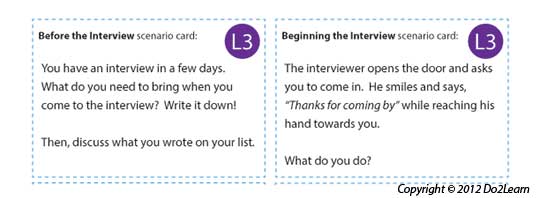
Communication systems and scripts provide the student with a means to initiate communication. Use these cards to practice different scenarios with your students.
|
|
Schedules are visual supports that organize the school or work day and tell the student where he will go that day. Schedules help focus attention on the sequence of places and events.
|
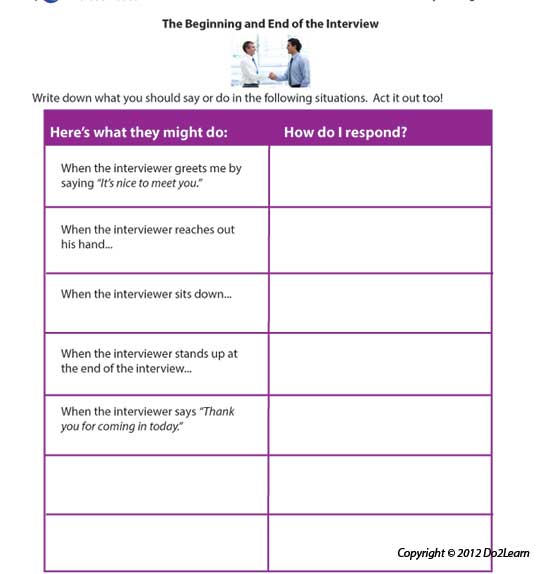
Graphic organizers can provide a student with a way to represent and organize concepts, thoughts, feelings, behaviors, and potential outcomes.
|
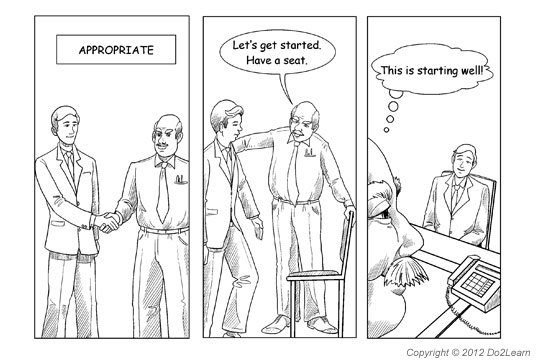
Social narratives are a set of tools that visually represent social situations and appropriate social behaviors. The social narrative connects the important details of a setting or social situation to support the student in understanding the social context and in developing a new social skill.
|
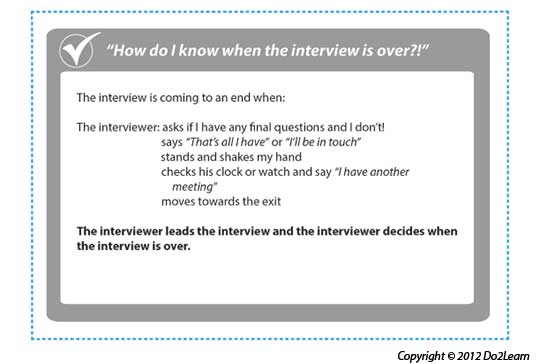
Visual Cues are learning materials that students can keep with them to help guide them through real life situations.
|
|
Video modeling involves the use of video recording as a teaching tool. It involves a student watching a video of the appropriate performance of a task (expected behavior) prior to practicing or potentially using the skill in natural settings.
|

Does the design of space and furniture help the student focus on the tasks and behaviors expected in the setting?
Certain interview environments can be highly distracting to some students. How might the environments differ between an interview conducted at a bank versus that of a high-paced restaurant occurring beside the kitchen with no closed door? It can be very demanding to apply the behaviors of focus on the interviewer, adjust voice volume, adjust body posture and direction, while confronting sensory elements that range from fluorescent lights to alluring paper weights on a desk. As the student demonstrates success in one setting, be sure to arrange practice opportunities within various environments or make subtle changes to the layout. Start with controlled settings and build self-confidence in the student’s interview behaviors before moving to unusual or more stimulating circumstances. Work towards the goal of helping the student recognize and respond to the general cues implied by a central desk or chairs facing one another. Target self-regulation of responses to other features within the environment (e.g., items on desk, pictures, fish tanks, and other objects that may be distracting).
It is unreasonable to expect that instruction can cover all possibilities. Try to adjust instruction based on challenges this student faces and the types of environments in which he is most likely to be interviewed. Doing so during controlled instruction will better prepare him for the real thing.
|