Managing Relationships with Co-Workers
Some workplaces have a very informal feel, while others demand strict adherence to social formalities. Some behaviors, like badgering someone who is not interested in a social relationship or committing sexual harassment, are never acceptable. Even a single inappropriate interaction with a co-worker or supervisor can be result in job loss, career damage, and even legal repercussions. Knowing what kinds of relationships and interactions are appropriate or inappropriate can be an advanced social skill, because cultural norms and expectations may vary from one workplace or person to another. The instructor must help the student navigate these social rules and expectations, and help them avoid inappropriate interactions. It is essential that the student learn to develop and maintain professional relationships with everyone they encounter in the workplace.

Teaching Ideas
Click on the icons below for detailed information on how to teach this skill.





 Guiding Questions
- How does the student manage interaction with co-workers?
- What are some of the student’s interests and hobbies? Does he share these with others? If so, how?
- Does the student have a framework to understand “friend” vs. “co-worker”? Can the student point to interactions that are associated with friendship?
- How does the student initiate conversations and other social exchanges?
- How does the student react to rejection?
- Does the student use any social media option such as Facebook, Instagram, Snapchat, Linkedin, etc.?
Visual Supports
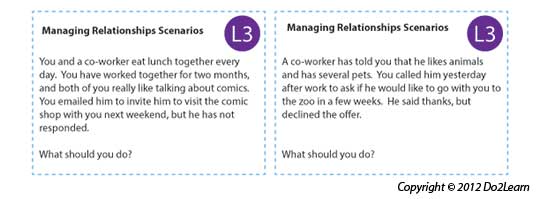
Communication systems and scripts provide the student with a means to initiate communication. Use these cards to practice different scenarios with your students.
|
Schedules are visual supports that organize the school or work day and tell the student where he will go that day. Schedules help focus attention on the sequence of places and events.
|
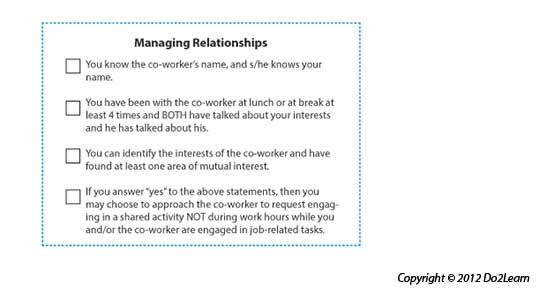
Graphic organizers can provide a student with a way to represent and organize concepts, thoughts, feelings, behaviors, and potential outcomes.
|
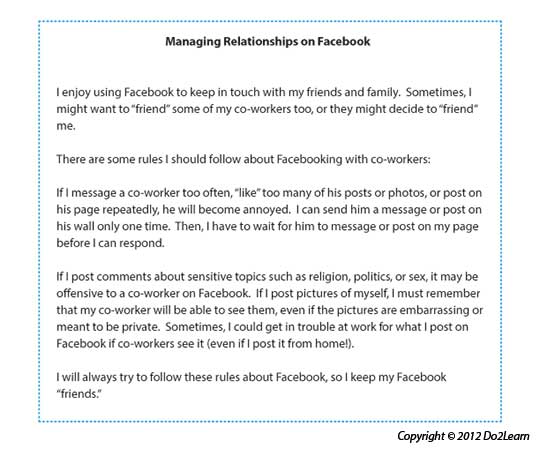
Social narratives are a set of tools that visually represent social situations and appropriate social behaviors. The social narrative connects the important details of a setting or social situation to support the student in understanding the social context and in developing a new social skill.
|
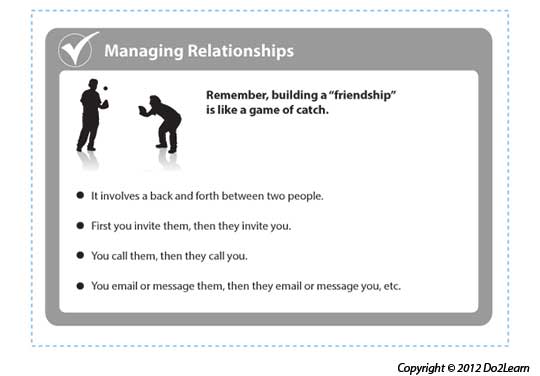
Visual Cues are learning materials that students can keep with them to help guide them through real life situations.
|
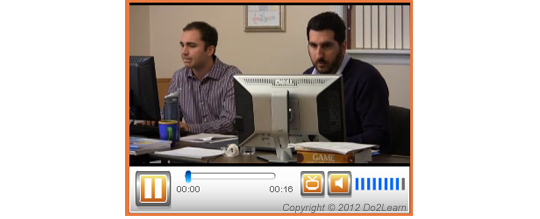
Video modeling involves the use of video recording as a teaching tool. It involves a student watching a video of the appropriate performance of a task (expected behavior) prior to practicing or potentially using the skill in natural settings.
|