Work Breaks
Breaks should be a relaxing time to rest, recharge, and take care of personal needs before returning to work. Some students may instead find breaks stressful, not knowing what to do with the unstructured time. As employees they must know where to go for breaks to avoid disrupting the work of others, and have a plan for acceptable activities to avoid engaging in inappropriate behaviors. They may need to pack a lot of activities into a short amount of time, which requires careful time management. Breaks may also include unstructured social encounters, which can be a source of anxiety for some students. Instructors can help students develop a clear strategy for break time, perhaps using visual organizers for time management and conversation starters to encourage friendly exchanges with co-workers. This will help the student look forward to breaks as a way to refresh before getting back to work.

Teaching Ideas
Click on the icons below for detailed information on how to teach this skill.





 Guiding Questions
- Does the student consistently go to and from a safe, designated break area without lingering in work areas where he might distract others? If he likes to talk, does he know who he can talk to?
- Does the student have difficulty organizing his time around appropriate break activities?
- Does he independently take care of toileting, snack or meal needs while on break?
- Does the student have difficulty choosing conversational topics or staying away from topics that could cause problems?
- Does the student have difficulty getting back from break on time? Does he have trouble stopping an activity when break time is finished?
- Does the student know when and how the use of a personal mobile/ cell phone is appropriate during the break?
Visual Supports
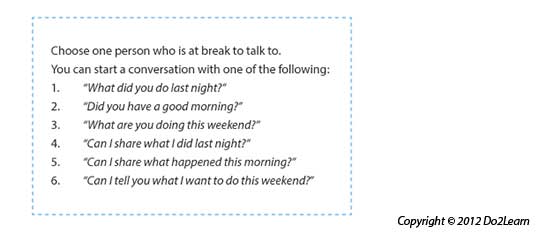
Communication systems and scripts provide the student with a means to initiate communication. Use these cards to practice different scenarios with your students.
|
|
Schedules are visual supports that organize the school or work day and tell the student where he will go that day. Schedules help focus attention on the sequence of places and events.
|
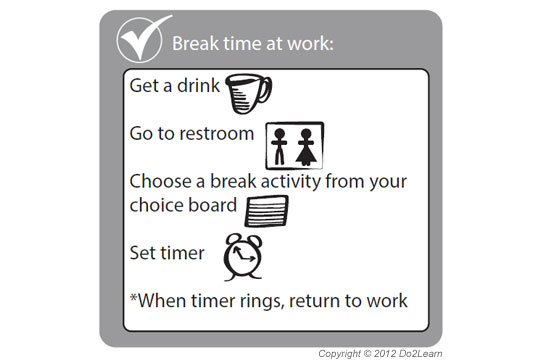
The to-do list (also referred to as a "work system"or "activity system") visually clarifies a series of activities that a student is to do.
|
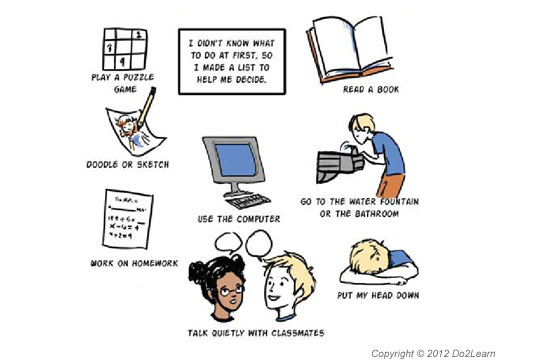
Graphic organizers can provide a student with a way to represent and organize concepts, thoughts, feelings, behaviors, and potential outcomes.
|
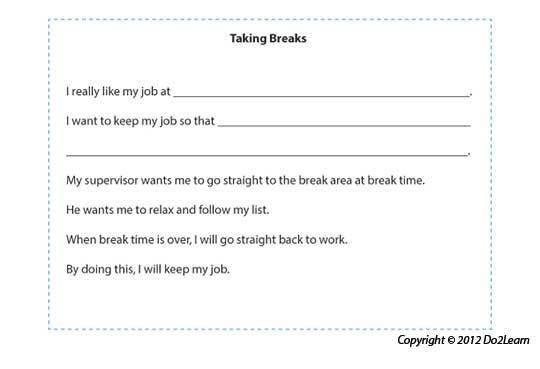
Social narratives are a set of tools that visually represent social situations and appropriate social behaviors. The social narrative connects the important details of a setting or social situation to support the student in understanding the social context and in developing a new social skill.
|
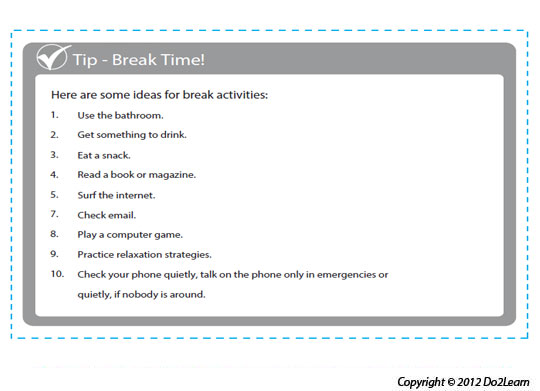
Visual Cues are learning materials that students can keep with them to help guide them through real life situations.
|
|
Video modeling involves the use of video recording as a teaching tool. It involves a student watching a video of the appropriate performance of a task (expected behavior) prior to practicing or potentially using the skill in natural settings.
|

Does the design of space and furniture help the student focus on the tasks and behaviors expected in the setting?
Carefully consider how the environment can be used to clarify the difference between ‘work’ and ‘break.’ In the classroom, is it possible (or necessary) to have a designated area where break activities occur? Many students will require environmental cues to help them work at work time and take a break at break time.
Is there a shelf with break activities readily accessible and visible within the space? If the student travels across classes throughout the day, are his “break” activities (magazines, headphones, journal, etc.) located in a backpack that he can readily access without disrupting those around him?
If time is a crucial feature of break activity (i.e., need to stop at a certain time), is a clock or timer in the immediate environment as a visual cue?
Does the environmental design address student issues with proximity to others or even distractibility that may reduce performance (working close to others may set up too much interaction)?
If personal interaction is reinforcing to the student, is the space designed to assure interaction without setting up inappropriate physical interaction (e.g. desks spaced apart, chairs on opposite sides of a table to support interaction)?
Is the space designed to support independent movement both within and between tasks?
Look carefully at the routes between spaces. Are they direct? How can I reduce distractions in route or remove temptations that will prevent quick movement?
|