Self-Advocacy
It takes self-confidence and self-awareness to be able to ask for the things that we need to get our work done in the best possible way. Self-advocacy can include requesting specific accommodations for a disability, standing up for legal rights, addressing a worrisome social situation, or even just knowing when and how to say “no” to a new responsibility that might be too much. In order to successfully advocate for their needs in the workplace or in educational settings, students must be able to recognize the problem, identify who can help them, initiate the request for help, and label and participate in the solution. A student who struggles with communication or self-esteem may have considerable difficulty in this process. Other students may be unaware that they are entitled to certain accommodations in the workplace. Instructors can help students identify areas where they may need help, and work with them to create a plan for self-advocacy. As the student becomes more comfortable advocating for their own needs, they will feel a greater confidence in their ability to function independently in the work environment.

Teaching Ideas
Click on the icons below for detailed information on how to teach this skill.





 Guiding Questions
- Does the student understand his own strengths and challenges?
- Does the student recognize who he can approach to help him meet his needs?
- Does the student have difficulty speaking up for himself and making his needs and wishes known?
- Does the student understand his role as a member of the IEP/504 team and how this document drives his supports in school? Does the student understand ADA and the protections it can provide to individuals with disabilities in the workplace or in post-secondary education settings?
- Does the student understand how he learns best and what accommodations he may need in the school or work setting to be successful?
- Does the student have the information he needs to make an informed decision about whether or not to disclose to others about his differences or needs?
Visual Supports
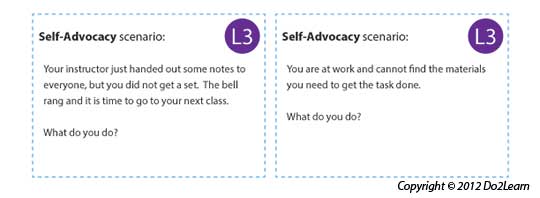
Communication systems and scripts provide the student with a means to initiate communication. Use these cards to practice different scenarios with your students.
|
|
Schedules are visual supports that organize the school or work day and tell the student where he will go that day. Schedules help focus attention on the sequence of places and events.
|
|
The to-do list (also referred to as a "work system"or "activity system") visually clarifies a series of activities that a student is to do.
|
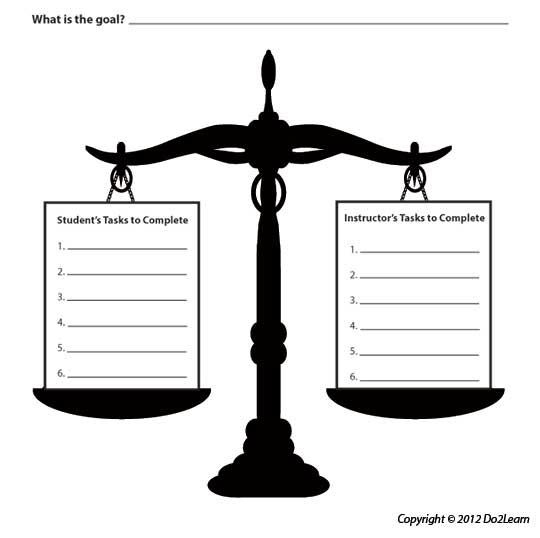
Graphic organizers can provide a student with a way to represent and organize concepts, thoughts, feelings, behaviors, and potential outcomes.
|
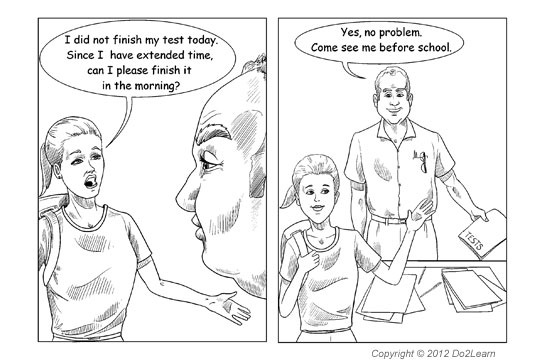
Social narratives are a set of tools that visually represent social situations and appropriate social behaviors. The social narrative connects the important details of a setting or social situation to support the student in understanding the social context and in developing a new social skill.
|
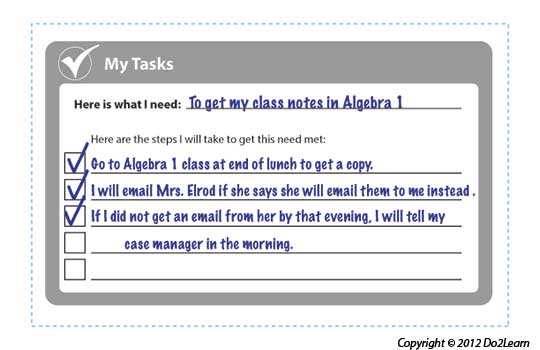
Visual Cues are learning materials that students can keep with them to help guide them through real life situations.
|
|
Video modeling involves the use of video recording as a teaching tool. It involves a student watching a video of the appropriate performance of a task (expected behavior) prior to practicing or potentially using the skill in natural settings.
|

Do you need to support the student in recognizing and advocating for certain needs that relate to environmental design (e.g., preferential seating, placement at a work area away from crowded pathways, a work station away from customers)?
Here are some examples of needs that you might support the student in recognizing and then advocating for (in school or on the job):
- To be seated at the front of the room, near the instructor
- In the back of the room if social anxiety is an issue, if social “visibility” is the student’s concern
- In a seat with an empty seat next to it if the student needs more “space”
- Away from the door if there is a lot of traffic
- Near an exit door if breaks should be readily accessible
- Placed near a conscientious peer/co-worker, and away from more distracting peers
- Placed in a lower traffic area, out of a direct path in the work or classroom setting
- Placed in a grouping arrangement with fewer students/co-workers
- Placed at a work area alone
- Placed in a separate work or testing setting
|