Repetitive Behaviors
Some people may display repetitive or stereotyped behaviors that could interfere with their ability to find or keep a job. Repetitive or stereotyped behaviors may include rocking, hand flapping, repetitive language, or the need to sort things. These behaviors can be disruptive in the work environment or may interfere with social interactions. Some students may engage in these behaviors to self-sooth, to reduce stress, to help them focus, or to provide sensory stimulation. Because these behaviors can sometimes provide a benefit to the student, the instructor should not seek to eliminate them entirely, but instead should help the student manage them so they are more socially acceptable. This may mean encouraging time limits on repetitive behaviors, scheduling “breaks” where the behavior is acceptable, or providing a specific safe location for the student when they feel the need to engage in the behavior. Instructors can also help the students self-advocate for workplace accommodations and to educate employers about why repetitive behaviors may occur. Through careful management and education, students can learn to feel more comfortable with themselves and their place in the work environment.

Teaching Ideas
Click on the icons below for detailed information on how to teach this skill.





 Guiding Questions
- Does the student exhibit repetitive or stereotyped motor movements that may be perceived as unusual? Examples include:
o Rocking
o Spinning items
o Hand flapping or squeezing
o Finger posturing
o Pacing
o Jumping
o Toe-walking
- Does the student exhibit repetitive or stereotyped language that may be perceieved as unusual? Examples include:
o Asking repetitive questions
o Bringing up repeated topics
o Repeating phrases or lines from movies, television, or books
o Using the same phrase over and over again (starting a question with the same “opening” phrase each time, for example)
- Why might the student engage in these behaviors? Is it a result of anxiety? Boredom? Self-stimulatory behavior?
Visual Supports
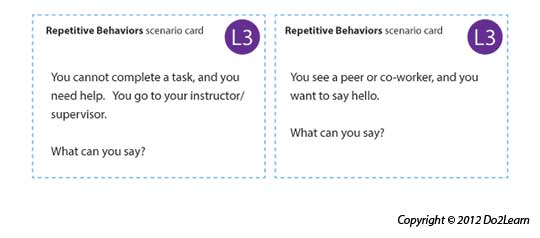
Communication systems and scripts provide the student with a means to initiate communication. Use these cards to practice different scenarios with your students.
|
|
Schedules are visual supports that organize the school or work day and tell the student where he will go that day. Schedules help focus attention on the sequence of places and events.
|
|
The to-do list (also referred to as a "work system"or "activity system") visually clarifies a series of activities that a student is to do.
|
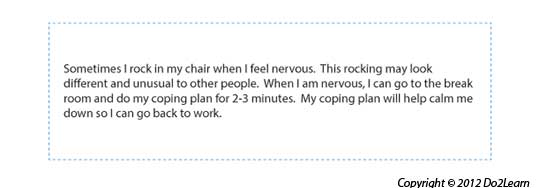
Social narratives are a set of tools that visually represent social situations and appropriate social behaviors. The social narrative connects the important details of a setting or social situation to support the student in understanding the social context and in developing a new social skill.
|
|
Visual Cues are learning materials that students can keep with them to help guide them through real life situations.
|
|
Video modeling involves the use of video recording as a teaching tool. It involves a student watching a video of the appropriate performance of a task (expected behavior) prior to practicing or potentially using the skill in natural settings.
|

Does the design of space and furniture help the student focus on the tasks and behaviors expected in the setting?
The physical arrangement of the work environment can be very important for an individual who is easily distracted by needing to fix things in their surroundings. If the student is looking at their surroundings and feeling a need to fix things, they will not be able to concentrate fully on their work. Some environments are disorderly by nature, and may not be a good fit for the student who needs to work in an organized, orderly environment.
Have the student work facing the wall rather than out in the open room. Use large bookshelves or dividers to limit their view of distracting surroundings. Or, have the student work in a cubicle or separate work space away from others to limit distractions.
Some individuals engage in repetitive behaviors when they are overwhelmed, anxious, or over-stimulated. Reducing noise and the amount of people in the work space may be necessary for some students. Teach the student to wear headphones if noise is problematic but difficult to control.
Does the environmental design address student issues with proximity to others that may reduce performance (working close to others may set up too much interaction)?
Perhaps the student has a choice peer or co-worker with whom he enjoys engaging. One of the issues of distractibility in this situation may come from the student repetitively asking questions or making stereotyped comments to the co-worker (which creates distraction for both individuals). Targeting the social skills for this issue will be necessary, but another strategy that will have a more immediate effect is modifying the environment to limit the student’s access to that worker. This may be with curtains, relocation of the work area, or even adjustment of the direction the student faces when working. Such environmental changes can help address these repetitive behaviors while the student is learning about the behaviors and is not yet at the level of independent self-management.
|