
Being a good team member requires knowing when and how to share knowledge with others. Some students will struggle with finding this balance, perhaps anxiously insisting that everyone do things “his way.” Others will remain too passive, not sharing useful ideas with their co-workers. No one likes to feel bossed around or, on the other hand, feel that a co-worker isn’t contributing to a project. Instructors should help students by setting clear standards for how often to offer help or suggestions. Scripts can help a student learn how to offer suggestions politely. Students can then feel empowered to share their ideas while avoiding any ruffled feathers in the workroom.

Click on the icons below for detailed information on how to teach this skill.





 Guiding Questions
- Does the student recognize when help is needed (and in some cases expected)?
- Does the student attend to the events occuring within the environment and personal signals of others (facial expressions, remarks, etc.) to determine that another may want help or suggestions?
- Does the student have a way of politely offering to help?
- Can the student attend to events occurring in the environment and personal signals to determine when to stop helping or offering suggestions?
- Is there a level of urgency or agitation present in helping or offering suggestions that should be addressed? In other words, does the student need to cope by self-labeling and self-calming if another person does not want his help or does not follow his suggestions?
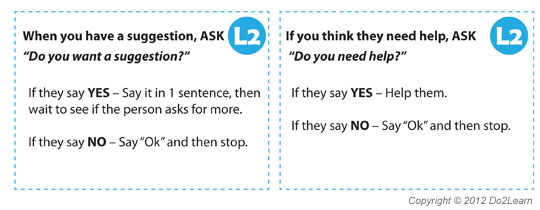
 Communication systems and scripts provide the student with a means to initiate communication. Use these cards to practice different scenarios with your students.
|
 The to-do list (also referred to as a “work system“or “activity system“) visually clarifies a series of activities that a student is to do.
|
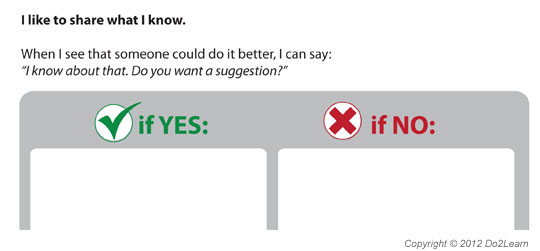
 Graphic organizers can provide a student with a way to represent and organize concepts, thoughts, feelings, behaviors, and potential outcomes.
|
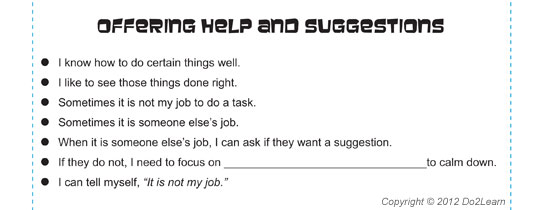
 Social narratives are a set of tools that visually represent social situations and appropriate social behaviors. The social narrative connects the important details of a setting or social situation to support the student in understanding the social context and in developing a new social skill.
|
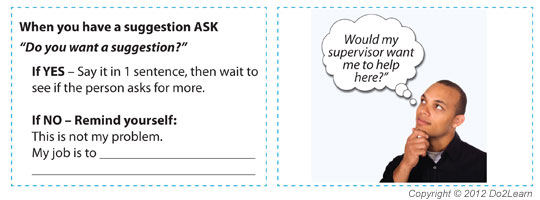
 Visual Cues are learning materials that students can keep with them to help guide them through real life situations.
|
 Video modeling involves the use of video recording as a teaching tool. It involves a student watching a video of the appropriate performance of a task (expected behavior) prior to practicing or potentially using the skill in natural settings.
|
 Does the design of space and furniture help the student focus on the tasks and behaviors expected in the setting? Initially, repeated practice in a controlled setting is likely to support fluency and confidence with the target behavior. Small group instruction automatically provides a safer environment for practice and for use of the visual support (narrative, script card, sequence card, etc.) Does the environmental design address student issues with proximity to others or even distractibility that may reduce performance (working close to others may set up too much interaction)? In initial practice with a student who becomes agitated when making suggestions, do you design the setting so that a lab table is between the students (stationed on opposite sides) or so that students are seated in designated spaces to prevent physical confrontation? |
