Family & Consumer Sciences
The family and consumer sciences offer a wide variety of job opportunities for a student who enjoys working with people and/or performing tasks related to food preparation or facility maintenance. Restaurants, cafeterias, hospitals, childcare facilities, and schools may all be viable job locations for a student with these interests. Because the tasks involved in the family and consumer sciences can range from the predictable and repetitive, such as chopping vegetables or rolling napkins, to the fast-paced, such as leading children’s activities, there are many opportunities for every personality. Help your student think about the many possible locations for food service and childcare jobs, and to assess what skills he or she may have or would like to develop.

Teaching Ideas
Click on the icons below for detailed information on how to teach this skill.





 Guiding Questions
- Will this environment fit the student’s strengths and interests?
- Will the environment provide either too much or too little stimulation, thus interfering with performance?
- Will the student achieve competence with the specific set of job duties within this job in a short period of time? If not, is it possible to adapt duties so that he can succeed while fulfilling the supervisor’s expectations for quantity and quality of work?
- Am I arranging visual supports so that the student is self-sufficient for the long term?
- Am I careful to avoid requiring too much ‘natural’ support from supervisors and co-workers?
Visual Supports
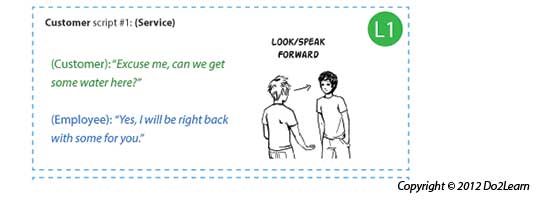
Communication systems and scripts provide the student with a means to initiate communication. Use these cards to practice different scenarios with your students.
|
|
Schedules are visual supports that organize the school or work day and tell the student where he will go that day. Schedules help focus attention on the sequence of places and events.
|
|
The to-do list (also referred to as a "work system"or "activity system") visually clarifies a series of activities that a student is to do.
|
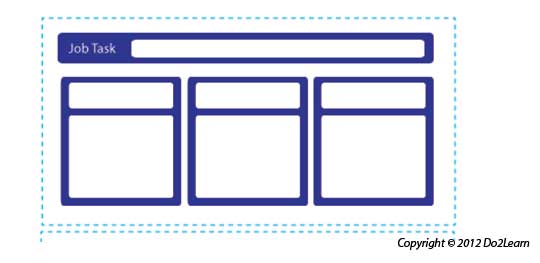
Graphic organizers can provide a student with a way to represent and organize concepts, thoughts, feelings, behaviors, and potential outcomes.
|
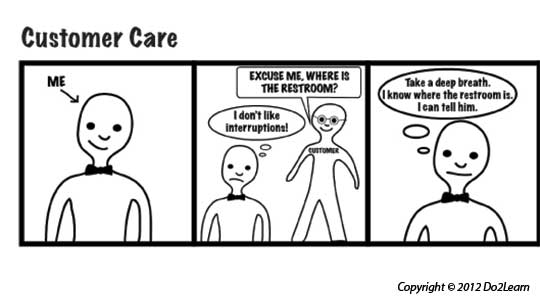
Social narratives are a set of tools that visually represent social situations and appropriate social behaviors. The social narrative connects the important details of a setting or social situation to support the student in understanding the social context and in developing a new social skill.
|
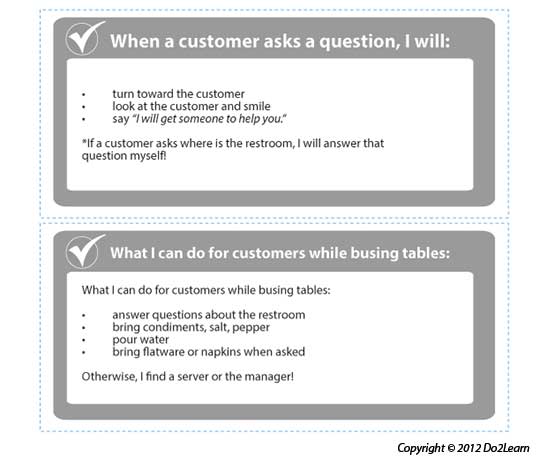
Visual Cues are learning materials that students can keep with them to help guide them through real life situations.
|
|
Video modeling involves the use of video recording as a teaching tool. It involves a student watching a video of the appropriate performance of a task (expected behavior) prior to practicing or potentially using the skill in natural settings.
|

Does the design of space and furniture help the student focus on the tasks and behaviors expected in the setting?
Food preparation lends itself naturally to clear and separate workstations that focus the individual’s attention on his work. Designing stations so that work naturally flows from left to right can speed performance. Design the station so that movements are reduced; assure access to tools in the space where they will be used. Look to design the space so that transitions to obtain needed foods and utensils involve only short distances. Attend to the amount of movement expected and to reducing distances between and within activities. If transitions are necessary to a kitchen sink, to a cooler, to a freezer, etc. arrange the task list or instructions so that the student gets everything he needs at one time. See if a cart or large tray or other physical support can be used to simplify the transitions and increase speed. Consider whether the workstation itself can be placed closer to specific areas that are a part of the task. While movement is often desirable for ‘active’ individuals, making this movement as consistent and specific as possible is equally desirable in preventing unnecessary interactions and distractions.
Attend as well to traffic patterns. Can the workstation be out of the line of traffic? Often an employer is willing to look at adjusting stations to support focus. Simply turning the station around so that it faces a wall can produce positive results. Are there unused spaces in the kitchen? Are there natural partitions like tall tray carts, alcoves, etc. that can be employed to focus attention on expected tasks? Containing the space by creating a workstation can reduce distractions and stimulation to support work.
Is the space designed to support independent movement both within and between tasks?
Look carefully at the distance between spaces in a work site. If materials for a task are in two separate areas, these may be reorganized for ease of access and closer proximity to where the work is completed. For instance, the set of shelves close to the student’s workstation may hold a variety of materials that are needed at times in food preparation. You may be able to adjust the places where work is done so that the student moves quickly between and within activities. Employers respond positively to suggestions of arrangement that will make workers more efficient.
Are there clear separate spaces for different contexts or sets of activities (i.e., place to take a break vs. workspaces vs. place for belongings, etc.)?
Restaurant and childcare sites may not have specific spaces for breaks for staff. As an instructor, identify a clear and consistent space to which the student can go for break and meals. Does the student need time to ‘unwind,’ to be away from interaction, or to engage in a specific activity that stabilizes or elevates his mood? Make sure that you help define both the space and the specific activities in which the student will engage during those break and meal activities. Staff may use a corner of the cafeteria for breaks and meals. Is this clear enough? If a site does NOT have clearly defined spaces, it may be worthwhile to consider how to create this organization of space for the individual. The individual may suggest to you that it is okay to take a break in the work area. However, the instructor should consider how likely it is that certain scenarios may occur in disorganized spaces. If the individual does not have a consistent place to put belongings and they get lost, what are the repercussions? If an individual has any confusion around meal behaviors, break behaviors and work rules, what happens when workspaces and break spaces are the same place? Is the individual more susceptible to confusion on the differing rules in these contexts? Does the clearly defined space support the student’s performance throughout the day? Confusion of this kind can pose a problem in sustaining a positive employment record.
|