Initiating Conversations
Initiating conversations is an important part of building both friendships and professional relationships. Conversations are a way to relate shared interests, convey information, and encourage positive feelings between people. Many students prefer to keep quiet, or would like to have a conversation, but are unsure whom to approach or where to start. Conversation starters can give students an idea of what to say when they’d like to talk with someone. Clear guidelines for when and with whom conversation is appropriate can ensure that the student avoids awkward moments. Social and professional relationships are built on shared conversations, and practicing this skill can help students feel comfortable approaching and talking to others.

Teaching Ideas
Click on the icons below for detailed information on how to teach this skill.





 Guiding Questions
- Does the student currently initiate under any conditions (e.g. sharing information about a particular topic of interest; asking a teacher, co-worker, or other person for help, etc.)?
- Does the student have an interest and desire for developing friendships or talking with other people?
- Does the student understand that the level of familiarity with people (family versus friends, acquaintances, teachers/bosses/other adults and strangers) dictates how he would approach the initiation of that conversation?
- Can the student evaluate the situation to determine if it is the right time and place to initate?
- Does the student know how to approach someone and gain their attention before talking?
- Does he know what to say to start a conversation appropriately? Does he know what to do with his body and facial expressions to start a conversation appropriately?
Visual Supports
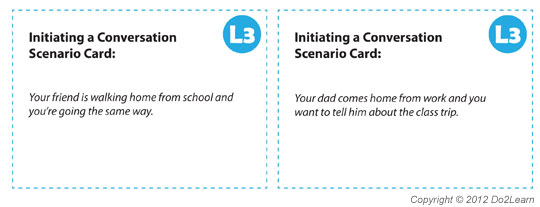
Communication systems and scripts provide the student with a means to initiate communication. Use these cards to practice different scenarios with your students.
|
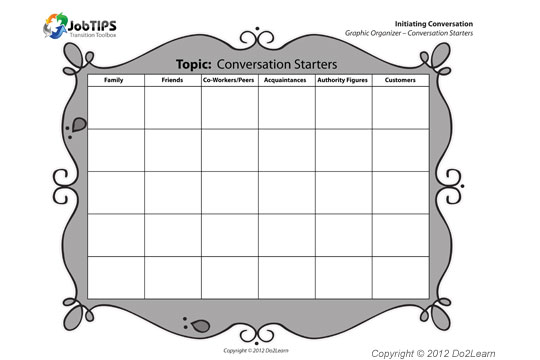
Graphic organizers can provide a student with a way to represent and organize concepts, thoughts, feelings, behaviors, and potential outcomes.
|
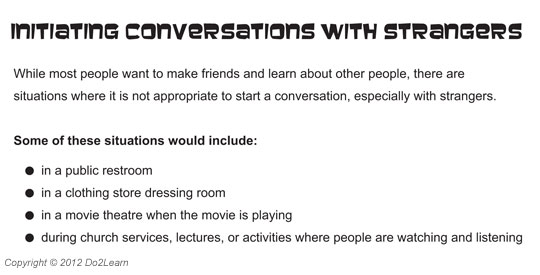
Social narratives are a set of tools that visually represent social situations and appropriate social behaviors. The social narrative connects the important details of a setting or social situation to support the student in understanding the social context and in developing a new social skill.
|
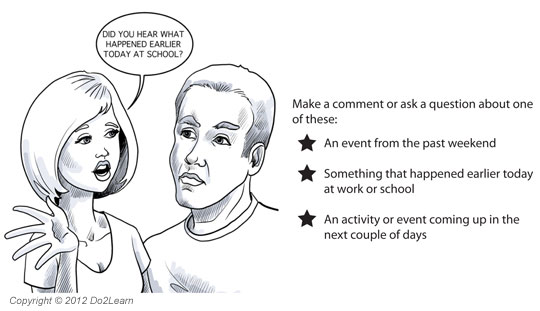
Visual Cues are learning materials that students can keep with them to help guide them through real life situations.
|
|
Video modeling involves the use of video recording as a teaching tool. It involves a student watching a video of the appropriate performance of a task (expected behavior) prior to practicing or potentially using the skill in natural settings.
|