Asking For Help
We can’t always solve every problem ourselves; sometimes, we need to ask others for help. New tasks, unfamiliar equipment, and unexpected situations are all a daily reality in the workplace. Rather than getting “stuck” in a problem, students must practice asking for help from co-workers and supervisors. This involves identifying that they need help, finding a potential source of help, approaching that person, articulating the problem, and asking for assistance. It can be useful for the student to have a clear plan of action about whom they should ask for help and what they should say. Saying “I don’t understand” or “Would you help me, please?” can be hard, but it can also open the door towards stronger relationships and learning new things.

Teaching Ideas
Click on the icons below for detailed information on how to teach this skill.





 Guiding Questions
- When the individual comes to a barrier or a problem, does he realize the problem and, second, does he realize he needs to find a solution?
- Does he recognize who might know a solution or with whom to share the problem?
- Does he have the skills to initiate communication about the problem and his need for a solution? How will he initiate this communication?
- Can the instructor support the student in connecting these varied circumstances so that the student develops a working concept of ‘help?’ In this way can the student learn to identify new and different contexts in which to communicate his need for help?
- Does the individual ask for help too frequently when the task is within his capability? Is this due to anxiety or is it an effort to seek attention?
Visual Supports
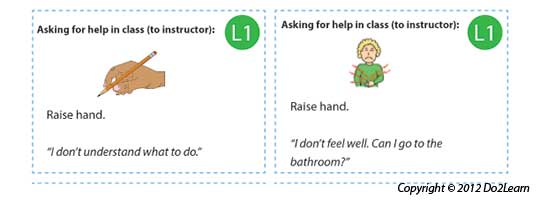
Communication systems and scripts provide the student with a means to initiate communication. Use these cards to practice different scenarios with your students.
|
|
The to-do list (also referred to as a "work system"or "activity system") visually clarifies a series of activities that a student is to do.
|
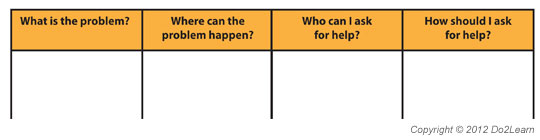
Graphic organizers can provide a student with a way to represent and organize concepts, thoughts, feelings, behaviors, and potential outcomes.
|
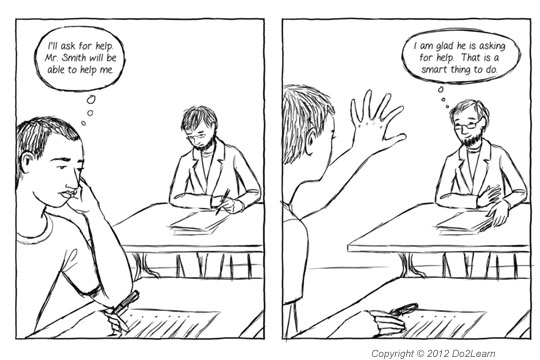
Social narratives are a set of tools that visually represent social situations and appropriate social behaviors. The social narrative connects the important details of a setting or social situation to support the student in understanding the social context and in developing a new social skill.
|
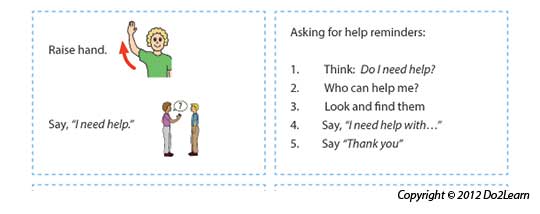
Visual Cues are learning materials that students can keep with them to help guide them through real life situations.
|
|
Video modeling involves the use of video recording as a teaching tool. It involves a student watching a video of the appropriate performance of a task (expected behavior) prior to practicing or potentially using the skill in natural settings.
|