Trade & Industrial
Some people enjoy working with their hands, building or fixing things such as houses, circuits, or plumbing systems. Others love working with cars or other machines. These students may thrive in trade and industrial jobs. Some of these jobs require significant technical experience, but many offer on-the-job training. Help your student consider what type of jobs they might enjoy, and to assess their current skills. They can then explore the many entry-level and service or volunteer positions that are available to help them further develop those skills. It may also be useful to direct them to supervised training programs in trades such as automotive repair, electric or heating installation, construction, or plumbing. These kinds of hands-on jobs can be an excellent area of employment for people who enjoy practical and concrete activities.

Teaching Ideas
Click on the icons below for detailed information on how to teach this skill.





 Guiding Questions
- Know the skill sets that are expected in the position!
- Will this environment fit the student’s strengths and interests?
- Will the environment provide either too much or too little stimulation, thus interfering with performance?
- Will the student achieve competence with the specific set of job duties within this job in a short period of time? If not, is it possible to adapt duties so that he can succeed while fulfilling the supervisor’s expectations for quantity and quality of work?
- Am I arranging visual supports so that the student is self-sufficient for the long term?
- Am I careful to avoid requiring too much ‘natural’ support from supervisors and co-workers?
Visual Supports
|
Communication systems and scripts provide the student with a means to initiate communication. Use these cards to practice different scenarios with your students.
|
|
Schedules are visual supports that organize the school or work day and tell the student where he will go that day. Schedules help focus attention on the sequence of places and events.
|
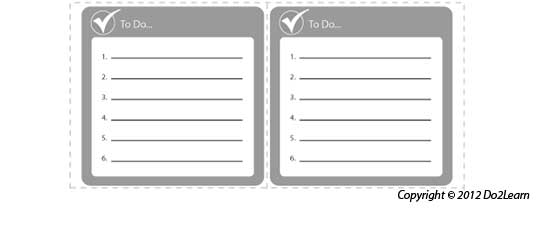
The to-do list (also referred to as a "work system"or "activity system") visually clarifies a series of activities that a student is to do.
|
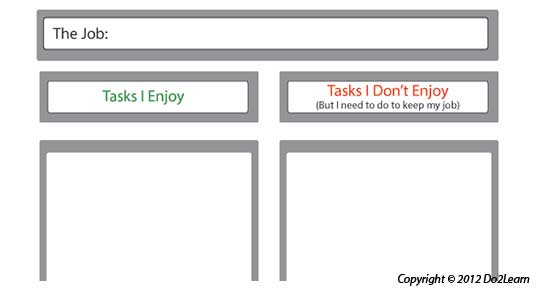
Graphic organizers can provide a student with a way to represent and organize concepts, thoughts, feelings, behaviors, and potential outcomes.
|
|
Social narratives are a set of tools that visually represent social situations and appropriate social behaviors. The social narrative connects the important details of a setting or social situation to support the student in understanding the social context and in developing a new social skill.
|
|
Visual Cues are learning materials that students can keep with them to help guide them through real life situations.
|
|
Video modeling involves the use of video recording as a teaching tool. It involves a student watching a video of the appropriate performance of a task (expected behavior) prior to practicing or potentially using the skill in natural settings.
|

Does the design of space and storage of equipment help the student focus on the tasks and behaviors expected in the setting?
Employers are often very responsive to our efforts to adapt the environment to improve work performance. Organizing equipment storage and labeling spaces will prove beneficial for all employees. In many garages, this is already well organized. Construction sites are less likely to be so precisely organized. Adjusting the storage of protective goggles, ear protection, gloves, and tools etc. in the truck so that the student has clear access to his needed materials in a clear space is desirable. If you can see how to organize materials to reduce transition distance and increase worker speed, you are the employer’s best friend. You may need to encourage the student to create a space in a construction site for his own materials. If this is not possible, does the schedule and to-do list direct him to where to find materials as needed? There is a good chance that discussion with the employer or supervisor about such adjustments will be met with a willingness to adapt.
Does the environmental design address student issues with proximity to others or even distractibility that may reduce performance (working close to others may set up too much interaction)?
The lifting and movement in a construction site can be productive activity that fits the individual’s need for vigorous activity. Is a flag or other marker used to define where materials will be placed when they come off the truck? Moreover, the openness of many sites is beneficial for an individual who is nervous or uncomfortable around numerous people.
Is the space designed to support independent movement both within and between tasks?
Look carefully at the distance between spaces in a work site. If materials for a task are in two separate areas, these can be reorganized for ease of access and closer proximity to where the work is completed. You can adjust the places where work is done so that the student moves quickly between and within activities. Employers respond positively to suggestions of arrangement that will make workers more efficient.
Are there clear separate spaces for different contexts or sets of activities (i.e., place to take a break vs. work spaces vs. place for belongings, etc.)?
Most employment settings have a separate break and/or lunch area. However, construction sites are not organized in this way. Defining within the schedule where the student may eat lunch or take a break may be necessary.
|