Coping with Bullying
Bullying and harassment can happen to anyone, and can have very serious and long-lasting results. Bullying is repeated negative and unwanted actions toward a victim by a person who intends to cause mental or physical harm. Harassment is offensive and unwanted action directed toward someone because of his or her disability, ethnicity, religion, gender, age, or sexual orientation. In most cases of bullying and harassment, there is an imbalance of power between the bully and the victim. Bullying and harassment are often illegal and should never be tolerated in the workplace or elsewhere.
Unfortunately, students with learning or social communication difference are often especially vulnerable to bullying. Any victim of bullying may feel powerless to stop the negative attention, particularly when they fear that their job or social standing may be in jeopardy if they report it. Students should be taught that bullying is not an expected “part of life,” and they should never be made to feel that they are at fault if they are bullied.
Because bullying and harassment can have such far-reaching negative consequences, instructors should work with students frequently to help them identify bullying, and to develop effective self-defense and self-advocacy strategies.

Teaching Ideas
Click on the icons below for detailed information on how to teach this skill.





 Guiding Questions
- Is this student a likely target of bullying in school, the workplace, cyberspace, etc.?
- Will the student struggle to recognize that he is being bullied? Remember that bullying comes in many subtle forms. Many students struggle to perceive that they are being manipulated or sabotaged, for instance. If this is a concern, target the Identifying Bullying Behaviors topic in conjunction with this topic.
- Does the student show any signs that he is being bullied? These might include such signs as depression, avoidance of school or work context, missing or damaged personal belongings, and social isolation.
- If the student recognizes that he is being bullied, how will he respond? What is he likely to say and do? What does he need to do instead?
- Does he have the skills to initiate communication about the bullying and his need for help? How will he initiate this communication?
- Even if the student does possess these skills, is he likely to tell a trusted adult if he is being bullied?
- What steps do you and other key stakeholders within the school or work setting need to take to promote the physical and emotional well-being of this student and all others who are likely targets of bullying? How can bullying be prevented or minimized?
Visual Supports
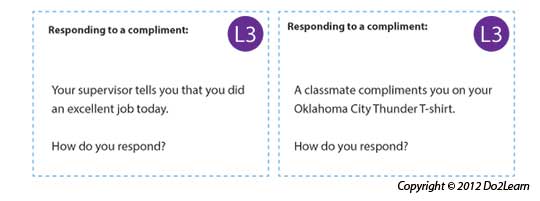
Communication systems and scripts provide the student with a means to initiate communication. Use these cards to practice different scenarios with your students.
|
|
Schedules are visual supports that organize the school or work day and tell the student where he will go that day. Schedules help focus attention on the sequence of places and events.
|
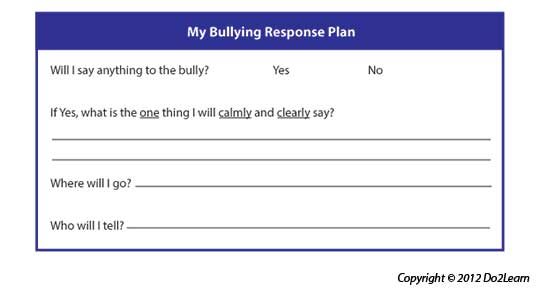
Graphic organizers can provide a student with a way to represent and organize concepts, thoughts, feelings, behaviors, and potential outcomes.
|
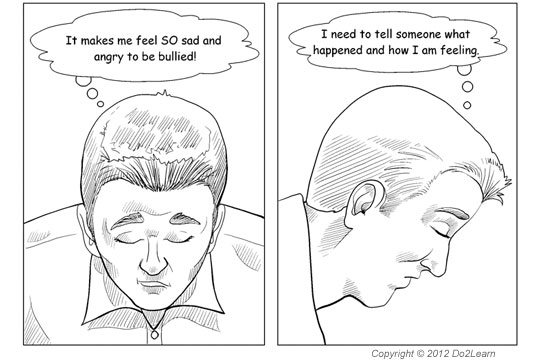
Social narratives are a set of tools that visually represent social situations and appropriate social behaviors. The social narrative connects the important details of a setting or social situation to support the student in understanding the social context and in developing a new social skill.
|
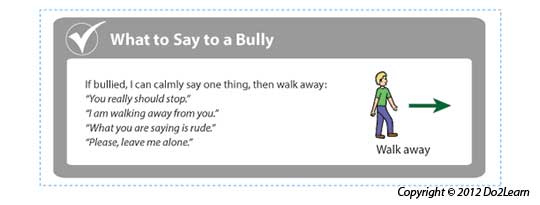
Visual Cues are learning materials that students can keep with them to help guide them through real life situations.
|
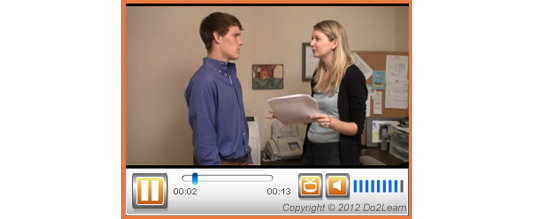
Video modeling involves the use of video recording as a teaching tool. It involves a student watching a video of the appropriate performance of a task (expected behavior) prior to practicing or potentially using the skill in natural settings.
|
Is the space designed to support independent movement?
Consider the WHERE TO GO feature of the response plan. Based on the school or work environment, where will the student go to escape a situation? Would he go to a designated adult’s office? Will he go to a space that has been designated for relaxation and breaks? The student needs a safe, accessible place to go where he can get help and de-escalate.
Are there clear separate spaces for different contexts or sets of activities (i.e., place to take a break vs. work spaces vs. place for belongings, etc.)?
|