Networking
Networking can be a very powerful and effective way to gain employment. Making social connections can open up new pathways to employers and build community relationships that expand job possibilities. Networking requires advanced social skills to identify and expand social networks and to appropriately contact acquaintances to ask for help in the job search process. Students should be helped to determine what types of networking will be comfortable for them, and should be encouraged to consider not just in-person or over-the-phone networking but also emailing, job fairs, and online networking websites. Instructors can help students identify networking possibilities in their schools, volunteer work, or communities. Having clear guidelines and scripts for contacting people in a network can help a student feel confident about using their social connections to help their job search.

Teaching Ideas
Click on the icons below for detailed information on how to teach this skill.





 Guiding Questions
- Is it within the student’s capacity to engage in any form of networking (face to face, via social media, email, etc.)? Or, will you and other key stakeholders engage in this networking on the student’s behalf?
- If the student will be able to initiate some forms of networking, is s/he most comfortable and competent with online networking, networking by phone, or networking in person?
- Can the student identify individuals who might be within his network (people who know him and like him, and might be willing and able to connect him with people who are hiring)?
- If you and the student have determined that he will be most successful and comfortable using online networking sites and emailing, does he require instruction on how to craft and proofread written messages? *In many cases, this is the most appropriate networking strategy to teach and use.
- If you and the student have determined that he will also engage in networking by phone, does he require instruction and repeated practice to determine what to say and how to say it during these telephone exchanges?
- If you and the student have determined that he might also engage in networking in person, does he require instruction and repeated practice in such areas as grooming and dressing for professional events, making introductions and initiating conversations, and other critical social communication skills that impact the job-seeking process?
- Is it appropriate for the student to consider attending job fairs (another form of networking in person)? *This is an overwhelming setting that is not a good option for most individuals on the spectrum.
- If your student chooses to contact people by using a social media platform, be sure to have them review the below “Basic Internet Tips” section and always remember proper Internet use, also called Internet Etiquette.
Visual Supports
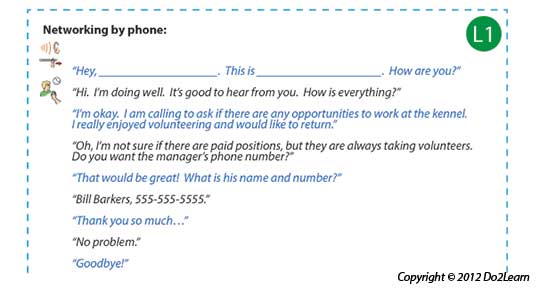
Communication systems and scripts provide the student with a means to initiate communication. Use these cards to practice different scenarios with your students.
|
|
Schedules are visual supports that organize the school or work day and tell the student where he will go that day. Schedules help focus attention on the sequence of places and events.
|
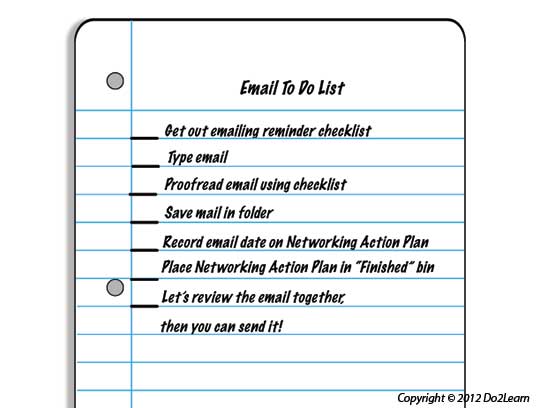
The to-do list (also referred to as a "work system"or "activity system") visually clarifies a series of activities that a student is to do.
|
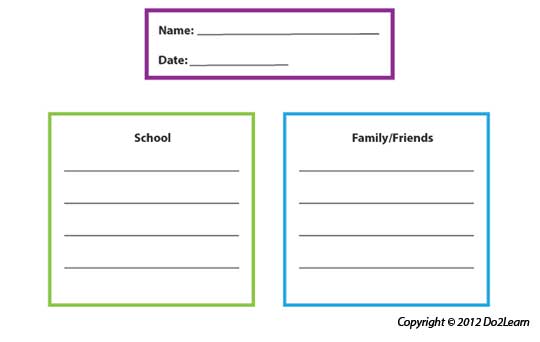
Graphic organizers can provide a student with a way to represent and organize concepts, thoughts, feelings, behaviors, and potential outcomes.
|
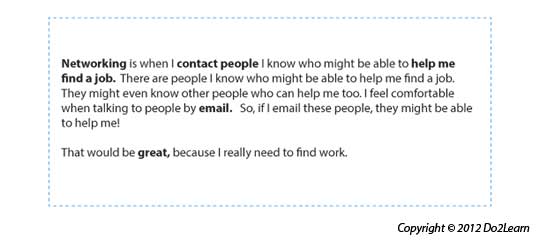
Social narratives are a set of tools that visually represent social situations and appropriate social behaviors. The social narrative connects the important details of a setting or social situation to support the student in understanding the social context and in developing a new social skill.
|
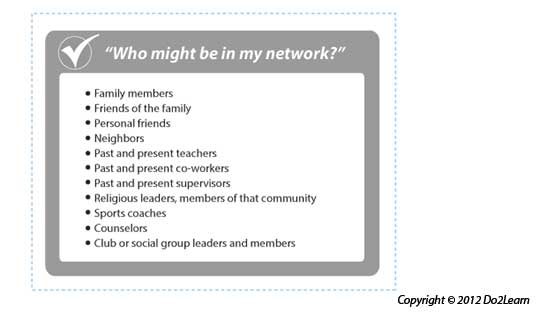
Visual Cues are learning materials that students can keep with them to help guide them through real life situations.
|
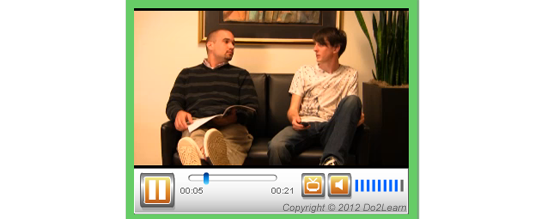
Video modeling involves the use of video recording as a teaching tool. It involves a student watching a video of the appropriate performance of a task (expected behavior) prior to practicing or potentially using the skill in natural settings.
|