 |
Getting a Job
Application Forms
Pre-Employment Screenings - Guidelines
Listed below are a number of tips that you should consider before you complete a Pre-Employment Screening Assessment.
 As you complete these assessments, we strongly suggest that you try to select the answer that you believe the company is looking for. This means that you need to use perspective-taking skills--What kind of employee does the company want? How would the company want an employee to behave in a certain situation? As you complete these assessments, we strongly suggest that you try to select the answer that you believe the company is looking for. This means that you need to use perspective-taking skills--What kind of employee does the company want? How would the company want an employee to behave in a certain situation?
For example, let’s say you are presented with the following question:
Michael is doing one of work tasks incorrectly. You know this because it affects your ability to complete his work tasks. Therefore, you often have to re-do Michael’s tasks in order to correctly do your own tasks. In this situation, you should:
- Tell your supervisor that Michael is doing his task incorrectly.
- Continue re-doing Michael’s task for him.
- Explain to Michael the correct way of doing the task.
- Talk to other employees about the situation.
How would the company want someone to respond in this situation? You should ask yourself this question before you select each answer.
Would a company want for you to tell your supervisor right away? No, because that seems like you are just complaining.
Would a company want for you to just keep doing Michael’s tasks over again? No, because that keeps you from doing your job tasks and makes you less productive.
Would a company want for you to gossip to other employees about Michael’s work? No, because that creates conflict and tension in the office.
A company would want for you to explain to Michael the correct way of doing the task (answer C). A company wants an employee who can work well with other employees, who offers support, and who tries to solve some issues without running to a supervisor every time a problem arises. |
As you complete these assessments, keep in mind what companies value most in their employees: Customer Service, Attitude, Safety, and Honesty. Companies need good employees in order to be successful. When employees have C.A.S.H., companies make more $$$ cash.
- Customer Service: From the company’s perspective, the customer’s satisfaction is most important. Employees must show a strong desire to help customers. Remember the old saying, "The customer is always right." This means that even when the customer says or does something wrong, an employee must treat that customer as if they are right.
- Attitude: The employee must always be willing to work on a team, to support co-workers, and to accept and follow supervisor’s instructions and feedback.
- Safety: Companies care about safety. They create rules and regulations to keep all employees and customers safe. They do not want their employees to break any of these rules, ever.
- Honesty: Companies want employees who are ethical, rule-following, and law-abiding.
Here are examples of questions relating to C.A.S.H.:
Customer Service question:
A customer is clearly very frustrated because she has been looking for a certain item in the store. She tells you that another employee was very rude and also gave her the wrong information about where the item is located. The best course of action is to:
- Ask the customer for the name of the employee so you can report them to your supervisor.
- Apologize to the customer and assist them in finding the item.
- Take the customer to your supervisor so they can express their complaints.
- Ask the customer for more information about what happened.
Attitude question:
Helping others makes me feel good. a. Strongly Disagree b. Disagree c. Agree d. Strongly Agree
Safety question:
A co-worker named Ben usually skips certain safety procedures steps. Ben says that he can get the job done much faster if he skips these steps and it seems like this is true. You always follow all of the steps, because that is what the company has told you to do. You decide to talk to your supervisor about this issue. What is the best reason for doing this?
- Because you don’t want to get blamed if something goes wrong.
- Because you want to follow the rules to maintain a safe environment.
- Because you don’t want Ben to look like a faster, better worker than you.
- Because the safety procedures might need to be changed.
Honesty question:
If everyone else is taking extra breaks at work, I should be able to do it too.
a. Strongly Disagree b. Disagree c. Agree d. Strongly Agree |
On these assessments, your selection of some answer choices might immediately eliminate you from consideration for employment. They are called "red flag" answers because when an applicant chooses those answers, it immediately puts up a red flag (or signal) to the company that the applicant could be troublesome. What kind of answer choices might be "red flag" responses?
- Any answer that suggests that you might steal company property
- Any answer that suggests that you might break safety rules and regulations
- Any answer that suggests that you might not be able to take direction and feedback from a supervisor
- Any answer that suggests that you might not be concerned with providing quality customer service
- Any answer that suggests that you might not follow company policies regarding work time, breaks, or absences
Examples of questions with "red flag" answers:
Any answer choices with a red flag next to them should be avoided!
1. Taking a few small things from a company is ok.
a. Strongly Disagree b. Disagree c. Agree d. Strongly Agree d. Strongly Agree
2. If I see a co-worker breaking a safety rule, it is not my responsibility to report them.
a. Strongly Disagree b. Disagree c. Agree d. Strongly Agree
3. Supervisors are there to help me do my job better.
a. Strongly Disagree b. Disagree c. Agree d. Strongly Agree
4. Difficult customers don’t deserve my assistance.
a. Strongly Disagree b. Disagree c. Agree d. Strongly Agree
5. Coming to work late and leaving early is not a big deal.
a. Strongly Disagree b. Disagree c. Agree d. Strongly Agree |
Most companies present questions that require you to respond using a rating scale. Here are examples of rating scales:
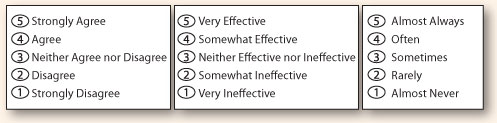
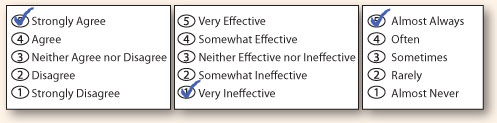
In most cases, companies are looking for an applicant who is confident and clear in their feelings about a certain issue. Otherwise, the applicant could seem wishy-washy (undecided and easily swayed). When a company asks questions that contain a rating scale, we recommend that you select an answer on one end of the scale. This is just our recommendation to you; ultimately, you need to select the response with which you are most comfortable.
|
Self-advocates actively seek out the things they need in order to be successful. Some individuals with disabilities are provided with accommodations (in school and / or on the job). A testing accommodation is a change in the way a test is administered or responded to by the person being tested.
If you feel that you might need certain accommodations in order to take these assessments, you may need to contact the Human Resources Department of the company. If you do seek testing accommodations, you may have to disclose to the company that you have a disability. You may also have to provide proof of this disability (i.e. school records, psychological evaluation results, recent I.E.P. or 504 plan, etc.).
Here are some accommodations that you might request:
- Extra time to complete the assessment.
- A paper version rather than an online version.
- Read aloud /audio version of the test.
Some companies might allow the use of certain accommodations, while other companies might not. It depends on a number of factors, including the company’s specific policies and current disability-related laws. Unfortunately, we cannot assure you that you can receive any testing accommodations when you take a pre-employment screening assessment.
|
We have developed two practice assessments with answer keys. Use these to help you get ready for the real thing!
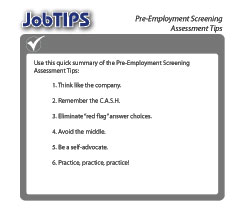
Use this quick summary of the Pre-Employment Screening Assessment Tips:
- Think like the company
- Remember the C.A.S.H.
- Eliminate "red flag" answer choices
- Avoid the middle
- Be a self-advocate
- Practice, practice, practice!

|
 |
GETTING A JOB
Application Forms
Pre-Employment Screenings - Overview |
|
GETTING A JOB
Application Forms
Pre-Employment Screenings - Practice Assessments |
 |
|
|