Before the Interview - Respond Like a S.T.A.R.
 Responding to behavioral questions in an interview can be tough. There are many different types of behavioral questions. Rehearsing responses to all of these questions can be a lot of work, though it is definitely a good idea.
However, you never know what exact question you will be asked in an interview, and the questions may be a little different from the sample questions provided in this website.
To help with this, use the STAR method. The STAR method is a way of preparing a few examples ahead of time that you could use for several different questions.
The STAR method is kind of like a formula that you can use to answer behavioral questions. If your answer “fits” into the STAR formula, it is more likely that you have answered the question completely and clearly.
Let’s break it down:
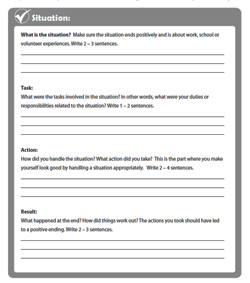
Situation:
- Give an example of a situation you were involved in.
- The situation should be related to a job, volunteer experiences, or school (includes academics, elective courses, club membership, sports, or fine arts).
- The result of the situation should be positive. Don’t pick a situation that ended negatively or one that makes you look bad.
Task:
- Describe the tasks involved in that situation.
- In other words, what were your tasks, duties, or responsibilities?
Action:
- Describe the action that you took to address the situation.
- In other words, how did you handle the situation? What did you do? This is the part where you make yourself look good by handling a situation appropriately.
Result:
- Describe what resulted from your actions.
- In other words, how did the situation end or resolve?
When answering a behavioral question, your response should include all four parts of the STAR.
Interview Question: “Tell me about a time when you had to work with someone who you did not get along with.”
Situation: “I was assigned to do a group project in Earth Science.But one of my group members did not care about his grade and he did not want to do any of the work. This made it hard to work with him.”
Task: “Our group had to carry out the experiment, and write up the results.We were supposed to do this together as a team.”
Action: “So, after class, I talked in private to the group member who was not doing his share. I politely told him how our team was really depending on him to help out.”
Result: “During our next class, this group member did do more work than the day before. He still had an attitude, but at least he was participating. We all got the job done.”
Let’s Review:
The interview question was: “Tell me about a time you had to work with someone you did not get along with.”
However, this STAR example could work for other interview questions that ask about your ability to handle conflict with others, such as:
- “Tell me about a conflict you have had with a peer. How did it end?”
- “How do you handle being around someone who does not do their fair share?”
- “Some people are not so easy to get along with. Tell me about a time where you had to work with someone in school or on the job who you did not particularly like.”
So, even though these questions are a little different, and even though the interviewee may not have prepared responses to each of these particular questions, their STAR example fits any of these questions. |
Interview Question: “What is the best thing for you to do when you are feeling overwhelmed by work or school tasks?”
Situation: “When I am under pressure to get something done,
Task: it is usually because I have a lot of work or school assignments to do.”
Action: “When this happens, I first like to write out a plan.”
Result: “This helps me see exactly what steps I need to take. I also set short-term deadlines for each step, so that the big, overall task does not seem so overwhelming. I set goals for how long I will work on a task each day, and that helps me manage my time. I give myself short breaks so that I can feel refreshed and in control.”
Let’s Review:
The interview question was: “What is the best thing for you to do when you are feeling overwhelmed by work or school tasks?”
However, this STAR example could work for other interview questions that ask about your ability to cope with stressful or frustrating situations, such as:
- “Describe how you handle pressure and stress.”
- “Did you ever feel like you had too much to get done, all at the same time? What did you do about it?”
- “What are some strategies that you use to stay calm under pressure?”
So, even though these questions are a little different, and even though the interviewee may not have prepared responses to each of these particular questions, their STAR example fits any of these questions. |
Interview Question: “Describe a time where you went above and beyond to help someone else.”
Situation: “My grandmother fell and broke her hip a few summers back.”
Task: “Since my parents work full-time and my grandfather passed away many years ago, we needed someone to take care of her. We were going to hire someone to help take care of her, but my family could barely afford this.”
Action: “Since this happened during my summer vacation, I went to my grandmother’s house every day for two months and helped her in every way that I could.”
Result: “We enjoyed our time together, and my family saved money.”
Let’s Review:
The interview question was: “Describe a time where you went above and beyond to help someone else.”
However, this STAR example could work for other interview questions that ask about your desire to help or serve others, such as:
- “Give an example of when you helped someone in need.”
- “Describe a time where you put your own needs aside in order to help someone else.”
- “Have you ever volunteered your time to help others?”
So, even though these questions are a little different, and even though the interviewee may not have prepared responses to each of these particular questions, their STAR example fits any of these questions. |
Now you are ready to rehearse your responses to standard and behavioral interview questions. Use this video series to help you rehearse.