Don't be a Bully!
It is also important for you to make sure that you are not intentionally or unintentionally bullying or harassing someone else at work. Some people with autism and other disabilities have trouble reading and displaying certain social cues. This means that they might have a hard time figuring out what another person is thinking or feeling in a situation.
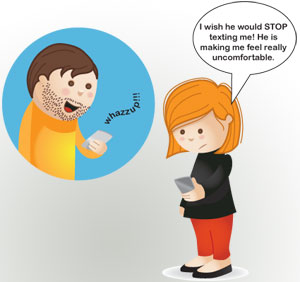 The individual with autism might not realize that their behavior makes the other person feel angry, uncomfortable, or offended. This also means that the individual with autism might say or do things that other people misunderstand. As a result, their words or actions might be viewed as bullying or harassment.
If you bully or harass someone at work (whether you mean to or not), you can get in big trouble. Here are some things that could happen if you bully or harass someone who you work with:
- You could get reprimanded by your boss.
- Co-workers might avoid you.
- Co-workers might gossip about you.
- Customers might report you to your supervisor.
- You could be fired.
- You could be charged with a crime if you harass someone, if you threaten someone, or if you physically assault someone.
You might not mean to make someone feel uncomfortable or offended. But even when you don’t mean to, your behavior might still be viewed as bullying or harassment.
 |
Repeatedly calling or texting someone who does not want to talk with you. |
 |
Making angry or threatening gestures towards someone who you do not like. |
 |
Sending repeated Facebook requests to someone who does not want to be Facebook friends with you. |
 |
Repeatedly staring at someone. |
 |
Repeatedly asking someone out on a date who does not want to date you. |
 |
Talking negatively about a certain ethnic group, sexual orientation, or gender. |
 |
Repeatedly sending romantic or admiring messages to someone who is not interested in you. |
 |
Repeatedly yelling or cursing at someone. |
 |
Repeatedly standing too close to someone (getting in their personal space). |
 |
Touching someone in a way that makes them feel uncomfortable. |
 |
Talking negatively about a co-worker’s political or religious views. |
 |
Repeatedly doing a behavior when it bothers someone and you have been asked to stop. |
*These are just a few examples. There are many other examples of bullying and harassment. |
So how can you know if you might do or say things that other people could perceive as bullying or harassment? It can be very difficult to figure this out.
Here are more obvious signs that you might be bullying or harassing someone:
- They ask you to leave them alone or stop (in person, by text, phone, or online).
- They tell you that you are not interested (in person, by text, phone, or online).
- Your supervisor, parent, or someone else tells you that you are behaving inappropriately.
Here are less obvious signs that you might be bullying or harassing someone:
- They don’t return your phone calls, text messages, or Facebook requests.
- They make annoyed or disgusted facial expressions at you.
- They seem to be avoiding you (they don’t speak to you very much, they don’t initiate conversations with you, or they walk away from you).
It can be hard to “read” other people sometimes. This means that it can be hard to figure out if you are doing or saying something that might make them feel uncomfortable, offended, or angry. It is VERY important for you to know the rules for appropriate work behavior, appropriate social networking behavior, and appropriate romantic behaviors. That way, you can avoid doing things that your co-workers might view as bullying or harassment.
Review the following sections carefully to help you learn and understand some of these rules:
 |
- Many people with autism have trouble reading the social cues, body language, and facial expressions of others. Therefore, you may not realize that your behavior or actions are making others angry or irritated.
- Whether you mean to or not, you can get in big trouble if you bully or harass someone. You could even get fired.
- A few examples of bullying or harassment include:
- Repeatedly calling or texting someone who does not want to talk to you
- Repeatedly asking someone on a date who does not want to date you
- Touching someone in a way that makes them feel uncomfortable
- Repeatedly doing a behavior that bothers someone when you have been asked to stop
- You may be bullying or harassing someone if you have been asked to stop (either by them or someone else, such as a supervisor or job coach), or if your actions are not received warmly (someone looks or acts annoyed, or you are beingignored). You should immediately stop your behavior in this situation.

|