
Skip Navigation Do2Learn Logo
Keeping a Job
Coping Strategies

Strategies - Relaxation Exercises

These exercises are designed to relax your body and to help you "quiet your mind"—to stop thinking about the things that make you feel stressed or upset.

Deep breathing exercises:

person breathing deeplyThis strategy requires practice ahead of time!  Learn and practice this strategy when you are calm.

What are they?  Deep breathing for relaxation means that you take slow, deep breaths in and out several times.  This seems easy, but it can take a while to get the hang of it.  However, it is a very effective strategy. 

Why?  Not only does deep breathing calm your body, but it also makes your mind focus on something else. Instead of thinking about what upset you, you concentrate on your breathing.

How long?  These exercises could last anywhere from 5 to 30 minutes.  Keep in mind that when you are at work, you may not be able to take a 30 minute break.  Set a timer for however long you have to remind yourself when your break is over.  You can set a timer on your watch, cell phone, or computer.

Where?  You will need a quiet and perhaps private place to do these exercises.  You might do these exercises at your desk, in a restroom, in your car, outside, or in the break room.

How?  Check out this demonstration of deep breathing exercises. Video
There are several printable aids that can help teach and remind you how to do deep breathing.  Look at all of them and choose the one that works the best for you:


Muscle relaxation exercises:

hand in a fistThis strategy requires practice ahead of time!  Learn and practice this strategy when you are calm.

What are they?  Muscle relaxation exercises mean that you tense muscles in your body and then slowly release the tension.  You usually do one body part at a time and move through the different parts of your body.  For example, you might tense and relax your shoulders, then left arm, then right arm, and so on, throughout your body.

Why?  Not only does muscle relaxation calm your body, but it also makes your mind focus on something else.  Instead of thinking about what upset you, you concentrate on your muscles. 

How long?  These exercises could last anywhere from 5 to 30 minutes.  Keep in mind that when you are at work, you may not be able to take a 30 minute break.  Set a timer (on your watch, computer, or cell phone, for example) for however long you are going to do these exercises- maybe 5-10 minutes.  This way you will have a reminder to get back to work.

Where?  You will need a quiet and perhaps private place to do these exercises.  You might do these exercises at your desk, in a restroom, in your car, outside, or in the break room.

How?  Check out this demonstration of muscle tension and release exercises. Video
Check out our printable visual aids for help:


Visualization / Imagery exercises:

Step 6 cardThis strategy requires practice ahead of time!  Learn and practice this strategy when you are calm.
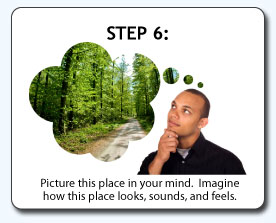
What are they?  Visualization or imagery means that you picture something pleasant or relaxing in your head.  You mentally picture something that makes you happy to calm yourself. 

Why?  Visualization can help you to shift your focus away from whatever is upsetting you. 

How long?  This strategy could last anywhere from 5 to 30 minutes.  Keep in mind that when you are at work, you may not be able to take a 30 minute break.  Set a timer for however long you have to remind yourself when your break is over.  You can set a timer on your watch, cell phone, or computer.

Where?  You will need a quiet and perhaps private place to do these exercises.  You might do these exercises at your desk, in a restroom, in your car, outside, or in the break room.

How?  Check out our printable visual aids for help: