Leaving a Job - Quitting a Job
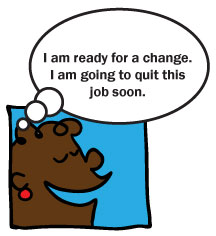 Quitting a job means that you choose to leave your job. You are not being told by your supervisor that you must leave.
There are many reasons why you might decide to leave a job:
- You may be moving away.
- You may have been offered another job.
- You may be starting school.
- You may be too busy to continue working at that job.
- You may be tired of working at that job.
- You may desire a job that is less challenging.
- You may desire a change.
- You may desire a more advanced or higher-paying job.
- You may desire a job that is less stressful.
- You may desire a job with different hours.
If you are bored of your job, need a change, or would like a more advanced, or higher-paying job, do not quit until you have found another job. Make sure you are hired by someone else before leaving your job. 
Whatever your reason is for leaving a job, you should make sure you handle the situation appropriately. This means that you should try your best to leave your job on good terms with your employer.
Why is it important to leave on good terms with your employer?
- So you can use them as a reference in the future.
- So you can work there again in the future if needed.
- So you do not get a bad reputation for being a difficult or rude employee.
- Because it is always a good rule to treat people respectfully and with consideration, even if you do not like them.
- Because they might know and talk to other people in the community about your performance as an employee. This could affect your ability to get a job somewhere else in the future.
 Make sure you give at least 2 weeks notice before leaving. If you can give your employer more time than that, that is even better. In fact, it is recommended that you give your employer 3 – 4 weeks of advance notice. Make sure you give at least 2 weeks notice before leaving. If you can give your employer more time than that, that is even better. In fact, it is recommended that you give your employer 3 – 4 weeks of advance notice.
 Your supervisor should be the first one at your work place to know that you are leaving. Do not tell co-workers or other people at work that you are leaving before your supervisor knows. It is most professional for your supervisor to hear the news from you rather than someone else at the work place. Your supervisor should be the first one at your work place to know that you are leaving. Do not tell co-workers or other people at work that you are leaving before your supervisor knows. It is most professional for your supervisor to hear the news from you rather than someone else at the work place.
 Arrange to meet with your supervisor to tell them that you are leaving. It is best to tell your supervisor in person (“face to face”). However, if it is difficult to arrange a meeting with your supervisor, or if you feel too uncomfortable meeting with your supervisor in person, a resignation letter is also appropriate. Arrange to meet with your supervisor to tell them that you are leaving. It is best to tell your supervisor in person (“face to face”). However, if it is difficult to arrange a meeting with your supervisor, or if you feel too uncomfortable meeting with your supervisor in person, a resignation letter is also appropriate.
 To arrange to meet with your supervisor, you could ask your supervisor in person, through email, or over the phone if they have time to meet with you. To arrange to meet with your supervisor, you could ask your supervisor in person, through email, or over the phone if they have time to meet with you.
Here are some examples of what to say:
- “There is something I would like to speak with you about. When would be a good time for us to talk?”
- “Could we set up a time today or later this week to talk briefly?”
Your supervisor may then schedule a time to meet you. However, your supervisor may also say that they can talk with you right then and there. Therefore, you should already know what you are going to say to them at this time.
 Prepare what you are going to say to your supervisor beforehand. You should write out what you are going to say and practice it. Have someone (e.g., a teacher, friend, family member, or counselor) role-play with you. Prepare what you are going to say to your supervisor beforehand. You should write out what you are going to say and practice it. Have someone (e.g., a teacher, friend, family member, or counselor) role-play with you. |
Giving your supervisor a reason why you are leaving your job can be tricky. You do not want to offend him or her when telling them why you are leaving. For example, if you are leaving because you hate your job, it is best not to say that. You are not required to give a reason why you are leaving. However, sometimes it helps to offer an explanation. There is also the possibility that your supervisor will ask you directly why you are leaving. Therefore, even if you do not offer the reason why, be prepared to respond to that question in case you are asked.
 Do not say anything negative about the job you are leaving. You can think these negative things, but do not actually say them to your supervisor. Remember, you want to leave on good terms. Do not say anything negative about the job you are leaving. You can think these negative things, but do not actually say them to your supervisor. Remember, you want to leave on good terms.
Think of a way to phrase your reason so that it is not offensive, does not hurt anyone’s feelings, or make the place of employment look bad. If you cannot do that, it is better to not give a reason than to say something negative about the job you are leaving.
You should not actually say any of these reasons to your supervisor because they are rude and unprofessional:
 “I hate this job.” “I hate this job.”
“I don’t like you.”
“I don’t agree with your policies and rules.”
“I don’t like the people I work with.”
“I am bored.”
“This job does not pay enough money.” |
You can say these reasons because they are polite and appropriate:
 “I have found a job that is a better match with my skills.” “I have found a job that is a better match with my skills.”
“I am moving to a new area.”
“I am starting school.”
“I was offered a job that is closer to my career interests.”
“I found a job that fits into my schedule better.”
“I have too many other commitments to continue working here.” |
 Be sure to thank your supervisor for giving you the opportunity to work there. Even if you did not like the job, it is best to show your appreciation. Remember, you may need your supervisor to provide a reference for you in the future, so you should stay on good terms with him or her! Be sure to thank your supervisor for giving you the opportunity to work there. Even if you did not like the job, it is best to show your appreciation. Remember, you may need your supervisor to provide a reference for you in the future, so you should stay on good terms with him or her!
 It is also nice to offer to help out as much as you can before you leave to prepare your workplace for your absence. This means that you could help train someone new to take over your tasks, or you could try to finish up as many projects or tasks as possible before leaving. It is also nice to offer to help out as much as you can before you leave to prepare your workplace for your absence. This means that you could help train someone new to take over your tasks, or you could try to finish up as many projects or tasks as possible before leaving.
|
Here are some sample scripts of how to tell your supervisor you are leaving. You can also use these scripts if you decide to email or call your supervisor to let them know that you are leaving the job.
 The people in these two scripts do not give a reason for why they are leaving: The people in these two scripts do not give a reason for why they are leaving:
“I wanted to talk to you about my job. I unfortunately am not able to continue working here after January. I have appreciated the opportunity to work here and would like to help out in whatever way I can until I leave.”
“Thank you for giving me the opportunity to work here; however, I am giving my official two weeks notice of resignation.”
This person is leaving because they are starting school:
“While I have really enjoyed working here, I unfortunately am going to have to stop working here starting in the middle of August. I was accepted into High Point University and will begin in September.”
This person is leaving because they found a job that is a better match with their interests and skills:
“I need to speak with you about my job here. I am sorry to say that I have to give my two weeks notice because I have found a job that better suits my interests and skills.”
This person is leaving because they were offered a new job:
“I have something important that I need to talk to you about. I am no longer going to be able to work here starting in two weeks. While you have been an excellent supervisor, I have been offered another job that is a great opportunity for me. I have really liked working here and would like to help make my transition go as smoothly as possible.”

|
 |
- Do not quit a job until you have been offered a new job.
- Make sure you give your supervisor at least 2 weeks notice that you are leaving.
- Tell your supervisor before you tell others at the work place. Your supervisor should hear your news first.
- Write down and practice what you will say ahead of time.
- If possible, tell your supervisor in person that you are leaving. You can also email or call them if that is easier for you.
- Leave on “good terms” with your employer by not saying anything offensive about your job or work place.
- Thank your supervisor for the opportunity to work there.

|