What to Wear
Each job has a written or unwritten work dress code. A work dress code is a set of standards or rules that companies create to help their employees know what is appropriate to wear to work. Dress codes vary from job to job.
Depending on the job, here is what you might need to wear:
 |
 |
 |
 |
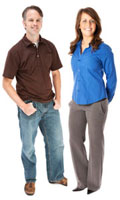
| Formal business attire |
Business casual attire |
Casual attire |
Uniform attire |
At some jobs, it is clear what you should wear because there is a work uniform for that job. For example, if you are a waiter/waitress, a nurse, a mechanic, or a mailman, you will probably wear some type of uniform.
In other jobs, there may not be an “official” dress code that is in writing, but you still need to dress appropriately to fit in with the work environment. Sometimes your supervisor will let you know the dress code for your particular job. Other times, it is up to you to either ask or figure it out. If you are not sure, you should ask your supervisor for rules about dress codes before starting your job so that you look appropriate at work.
What you wear is important so that you look appropriate and fit in at your workplace. 
There are some rules that apply for almost all jobs. Ask yourself these questions before you leave the house:
- Is my outfit appropriate for this work setting?
- Does my clothing fit appropriately (not too tight, not too loose)?
- Do my clothes match?
- Are my clothes clean?
- Do my clothes smell good/clean?
- Are my clothes wrinkle-free?
- Are my clothes stain-free?
If the answer is “yes” to all of these questions, you’re ready to go to work!

|
If you need to dress “business casual” (e.g., a librarian, office worker, teacher)
- No t-shirts (instead, wear a shirt with a collar or a sweater).
- No shorts either (instead, wear long pants).
- No hats.
- Tuck in your shirt.
- Wear a belt.
- Make sure your belt is the same color as your shoes.
- No flip flops (instead, wear close-toed shoes).
- No low-hanging pants.
|
- Make sure your shirt covers your stomach and your back. Try these tests:
- Reach up to the ceiling. Does your stomach show? If not, you’re ready to go! If it does show, try to find a shirt that is long enough to cover your stomach.
- Reach down to touch your toes. Does your shirt still cover your back? If it does, you’re ready to go! If not, try to find a shirt that is long enough to cover your back.
- Make sure your shirt is not low-cut. You should not show cleavage in any work setting. Try this test:
- Stand in front of a mirror and lean forward. Can someone see down your shirt? If so, wear a different shirt.
- No shorts or skirts that fall several inches above the knee (instead, wear knee-length or longer skirts, pants, or Capri pants).
- No flip flops (instead, wear sandals or flats).
|
For more information about what to wear for specific jobs, see the Job Descriptions section.