Should You Disclose?
There are certain situations when it is a good idea to tell your supervisor about your diagnosis. Telling your supervisor about your diagnosis allows him or her to understand you better. It can explain why you may do things a certain way or behave a certain way. A lot of times, when people understand the reason behind something, they are more tolerant and accepting.
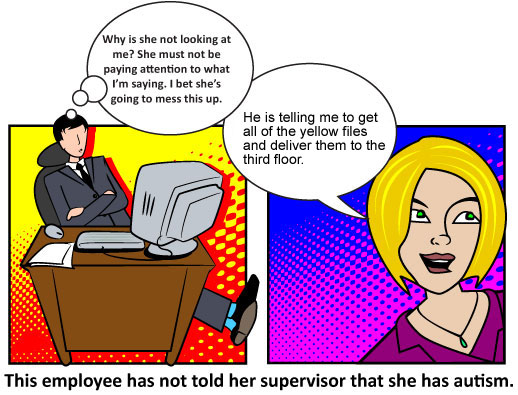
For example, your supervisor may think you are being rude by not making eye contact with him, or he may assume you are not listening because you are not looking at him. However, if he knew that making eye contact is hard for you because you have an autism spectrum disorder, he will be less likely to be offended or think you’re not listening. Instead of jumping to the conclusion that you are rude or not paying attention, he understands and accepts that this is a part of who you are.
Here’s when to tell your supervisor about your diagnosis:
- If you have social difficulties that are obvious and may interfere with you getting a job.
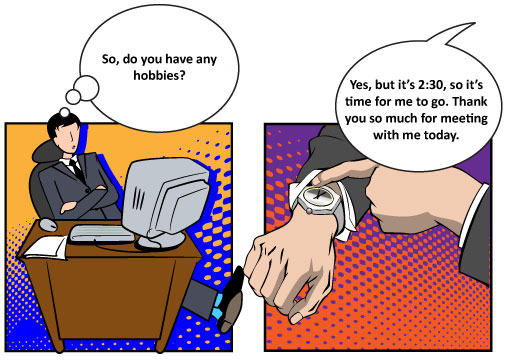
Example: You miss certain social cues, such as when to leave at the end of the interview. You leave your interview promptly at 2:30 because your scheduled half-hour is over, even though your interviewer is making small talk with you. Your timing for leaving the interview is abrupt and appears rude. However, if your interviewer knows you have autism, they may understand that you strictly adhere to times and schedules, and will realize that you would be very punctual when arriving to work each day, which is a positive characteristic.
 If you have social difficulties that are obvious and interfere with keeping a job.
Example: You are getting overwhelmed and stressed because you work in a room with several other people working in it. The chatter of your co-workers is distracting and irritating. You should not yell at your co-workers to be quiet. Instead, you could tell your supervisor about your diagnosis and an accommodation could be arranged, such as having your own office or being allowed to wear headphones.
- I
 f the symptoms of your diagnosis interfere your ability to complete your work accurately.
Example: You have trouble following multiple-step procedures without having them written down. You listen to your supervisor’s instructions and then forget what to do because you don’t have a written list to refer to.
If your employer knows that keeping multiple steps in your head is difficult for you, he or she can write down instructions for you rather than giving them to you verbally. In fact, this helps most people.
In all of these examples, your interviewer or employee would be able to understand your behavior if they knew about autism spectrum disorders. But without that knowledge, they would probably think your behavior was inappropriate.
Here’s when NOT to tell your supervisor about your diagnosis:
- If you are certain that your differences are not noticeable to others and will not interfere with your job performance or interviewing skills.
- If you are uncomfortable with others knowing about your disability. Some people don’t want anyone to know about their disability and want to keep this information private. There is absolutely nothing wrong with having an autism spectrum disorder. If you do not want others to know, that is your right to keep that information private.
*If you are uncomfortable telling others, but you are having trouble getting or keeping a job, you may want to consider telling your supervisor, but not your co-workers. By only having one person know about your differences rather than everyone you work with, you may feel more comfortable. Ask your supervisor to keep your diagnosis confidential if you are not comfortable with everyone else knowing.
Disclosure is a personal decision. It is totally up to you what you decide to do, and there is no right or wrong approach. Talk it over with someone you trust if you need help deciding, such as a family member, mentor, counselor, or friend.
 |
Here’s when to tell your supervisor about your diagnosis:
- If you have social difficulties that are obvious and may interfere with you getting a job.
- If you have social difficulties that are obvious and interfere with keeping a job.
- If the symptoms of your diagnosis interfere your ability to complete your work accurately.
- If you would need reasonable accommodations in order to perform your job duties.
Here’s when NOT to tell your supervisor about your diagnosis:
- If you are certain that your differences are not noticeable to others and will not interfere with your job performance or interviewing skills.
- If you are uncomfortable with others knowing about your disability.
- If you are uncomfortable telling others, but you are having trouble getting or keeping a job, you may want to consider telling your supervisor, but not your co-workers.

|