Roles & Hierarchy
When you have a job, it is likely that you will work with other people. Sometimes it can be confusing to figure out who does what, what their position is, and how they relate to you.
The chart below shows a general framework of the different positions at work in relation to you. In other words, this chart shows a workplace "hierarchy."
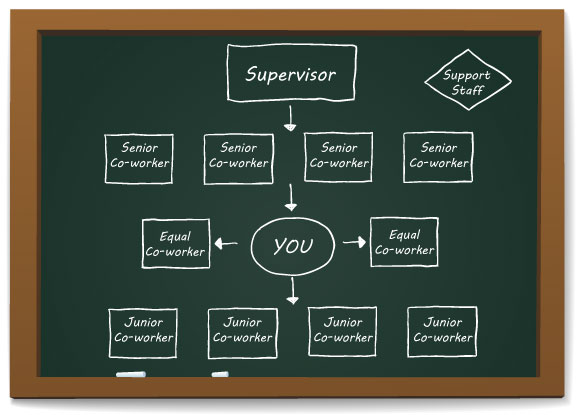
It is important to note that no matter where a person is on this "hierarchy," they should be valued and treated with respect by everyone.
So, what exactly are these positions and how do they relate to you?
A supervisor is someone who is in charge. Another word for supervisor is “boss.” Many workplaces have more than one supervisor. There may be an overall supervisor, and then several other supervisors who work for them. People in supervisory positions often have titles such as “director” or “manager.”
 Why do you need to know this? Why do you need to know this?
Your supervisor is in charge of you at work, and when he/she tells you to do something, you need to do it. You need to pay attention and listen to your supervisor. Your supervisor has the power to fire you if he/she does not think you are doing a good job so it is important to impress your supervisor. Your supervisor is also someone who you can go to if you have questions or are having problems at work. Your supervisor is also there to help you.
Over time, you might earn the right to become a supervisor. |

This refers to co-workers who have a higher position than you. They may have more experience, have a higher degree or training, or may have worked for the company longer than you. They likely have more responsibility than you, may make more money, and could potentially supervise you at times. This means that they might have the authority to tell you what to do sometimes.
Why do you need to know this?
Co-workers who are “above” you in title or rank are important to you if you work directly with them at times. You can learn from these co-workers because they may have more knowledge or experience than you. Because these co-workers are closer to the supervisory position than you, they may have a say in who gets hired or fired. They may report back to your boss about your work and effort level.
Over time, you might be in a position where your title or rank is higher than some of your co-workers. |
Many workplaces have several people in the same position. For example, there may be several baggers at a grocery store – these are different people, all doing the same tasks. Co-workers who are at the same level or position as you may work at the same time you work, or they may work at a different shift depending on how big the workplace is. They will likely make the same amount of money as you do (or close to the same amount). They may or may not have similar training or background as you.
Why do you need to know this?
These are the co-workers who you may interact with the most. If they have the same position as you, you will be doing the same things as them. Although these co-workers are at the same level as you, you may still learn things from them, just as they may learn things from you. It is nice to get along and work as a team with co-workers in the same position as you. |
This refers to co-workers who have a lower rank than you at your workplace. They may have less experience, have less training or education, or worked at the company less time than you. They likely have less responsibility than you, make less money, and you could potentially supervise them at times.
Why do you need to know this?
You may interact with co-workers more junior than you, or you may not. You may even be in charge of these co-workers. Co-workers more junior than you may be able to help you at work and may eventually move up to the position you are in or higher. Everyone starts at the bottom at some point, so you must always be respectful of your co-workers no matter what their role. |
Support staff, or ancillary staff, could mean a variety of different things depending on where you work. Often, support staff includes Information Technology (IT) specialists, administrative assistants, and sometimes custodial workers. You may even work in a support staff position. But if not, these staff members are people who work behind the scenes to make things go smoothly at the workplace.
Why do you need to know this?
Support staff can be of great help to you. Administrative assistants are often there to help with office tasks, such as mailings, filing, photocopying, and more. But please check with your supervisor before asking for help from administrative assistants because they may be assigned to help certain people or only do certain tasks. Computer support staff can help with technical issues you may experience at work, but again, ask your supervisor before consulting with IT or computer support. Finally, custodial workers help keep the workplace clean and pleasant. |
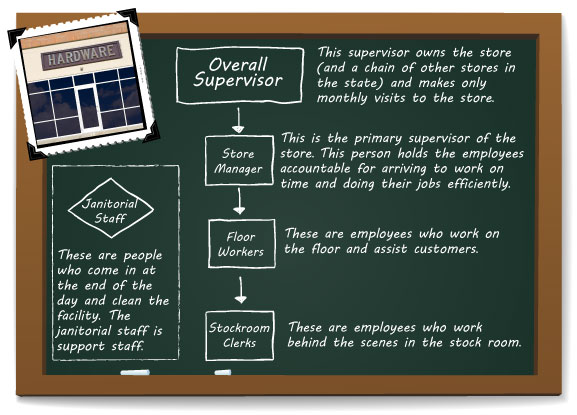
Here’s an example of a workplace hierarchy at a hardware store.