Strategies - Situational Stories - Understanding Social Situations
Why should I use these stories? These stories can help you better understand and cope with certain situations.
What should my story be about? The topic of your story can relate to anything that makes you feel stressed, anxious, confused, sad, angry, disappointed, irritated, bored, afraid, uncomfortable, or over-stimulated. 
Need help coming up with topics? Check out these for help:
What should I include in these stories? In most cases, you should include these parts in your stories:
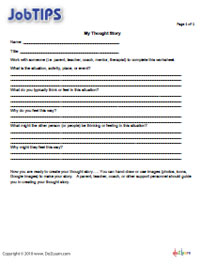
- A description of the situation, activity, place, person, or event.
- A description of what you typically do in that situation (how do you behave, what do you say, how do you feel?).
- A description of what other people might be thinking, feeling, or doing in this situation.
- A description of what you should try to do - what is a better way for you to handle the situation?
- Why should you try to respond differently? How will it make the situation better?
- End on a positive note - you CAN do it!
- You can include your own drawings, symbols, icons, images, photos, or any other visual aids to help you "tell" this story.
How do I create these stories?
You can hand-write, type, or audio record these stories.
When should I review these stories?
Once you have written a story, you should review it on a regular basis AND when particularly stressful events occur. Review these stories with a "support person" (i.e. parent, teacher, coach, mentor, therapist) as needed.
Where should I keep these stories?
In a binder, notebook, on a hand-held device, or on your computer.
A parent, teacher, mentor, coach, or therapist should instruct and guide you in developing these stories. You will need their guidance and instruction for several reasons:
- You might need help identifying story topics.
- You may need help identifying and describing how you typically respond in certain stressful situations.
- You may need help identifying and describing a more appropriate response to deal with these situations.
- You may need help identifying the perspectives (thoughts, feelings, intentions) of others.
 My Story about "Accepting Feedback" My Story about "Accepting Feedback"
Almost everyone has a supervisor in their job. A supervisor is in charge of certain employees. A supervisor’s job is to make sure that all of their employees are doing their job accurately, safely, and efficiently. Supervisors also make sure that employees follow the rules at work. If a supervisor does not do these things, then they could get in trouble with their boss.
It is my supervisor’s job to give feedback—positive and negative. Sometimes, my supervisor tells me that I have done a good job. At times, my supervisor tells me to correct my mistakes. This makes me feel frustrated, and I don’t like it when I make mistakes. Everyone makes mistakes at work sometimes. When my supervisor gives me negative feedback, I need to try to stay calm, take a deep breath, and tell my supervisor that I will correct the mistake right away. I will always try to accept feedback in a calm and respectful manner because I want to keep my job. It is important for me to keep my job.
My Story about "Selecting Appropriate Topics of Conversation"
 When I am at work, there are times where I enjoy talking to my co-workers. I usually chat with them during breaks, at lunch, and outside after work. When people have social conversations, they like to talk about a variety of topics. At work, many people like to chat about things like the weather, their weekend plans, events in the news, sporting events, and popular music, movies, and television shows. When I am at work, there are times where I enjoy talking to my co-workers. I usually chat with them during breaks, at lunch, and outside after work. When people have social conversations, they like to talk about a variety of topics. At work, many people like to chat about things like the weather, their weekend plans, events in the news, sporting events, and popular music, movies, and television shows.
When I talk to people, I usually want to talk about my special interests. However, I need to try to remember that not everyone wants to talk about the same things as I do. People might feel bored or irritated if I talk about my interests too much.
When I am talking to my co-workers, I should try to ask them questions about the things that they are interested in. My co-workers will appreciate it if I show interest in them. This will probably improve my relationships at work. When I have good relationships at work, I will probably enjoy my job even more.
My Story about "Asking for Help"
 I want to do my job correctly, and feel proud of myself when I do a good job. Most of the time, I know exactly what I am supposed to do in my job. Sometimes, I am not sure how to complete a certain task. When I am not sure how to complete a certain task, I should always try to ask for help. I want to do my job correctly, and feel proud of myself when I do a good job. Most of the time, I know exactly what I am supposed to do in my job. Sometimes, I am not sure how to complete a certain task. When I am not sure how to complete a certain task, I should always try to ask for help.
To get help at work, here’s what I should try to do: Write my question down, go and ask someone, or call a supervisor. I might ask a co-worker if I think that they can help me. I can also ask a supervisor if I want to be sure I get the right answer. If I don’t ask for help, I might not do my job correctly. Everyone needs help sometimes. It is okay to ask for help. When I ask for help, I can do my job correctly.

|