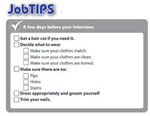
You always need to look professional for an interview. This means:
 No jeans or sweatpants No jeans or sweatpants
No shorts
No t-shirts
No flip-flips or sneakers |
No rips, holes, or stains in your clothes
No hats
No sunglasses indoors |
Instead, you should always wear:
 Clean clothes Clean clothes
Clean shoes (preferably polished or with limited scuffs and scratches)
Matching belt and shoes (example: black belt = black shoes)
Wrinkle-free (ironed) clothes
Clothing that fits – not too tight, and not too loose! 
Formal Interviews:
If your interview is formal, you need to dress formally. When you are interviewing for some jobs it is almost always appropriate to wear formal interview attire. These include jobs in such areas as business, banking, accounting, education, research, office administration, information technology, graphic design, and a number of other professional fields. Also, if your interview is all-day, it is probably a formal interview.
Formal interviews for Men:
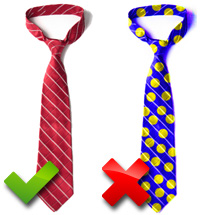
- Men should wear a suit and tie. Your suit should be a neutral color, such as black, gray, or navy. Avoid loud or distracting colors for your tie.
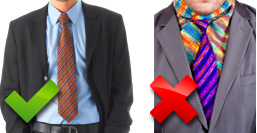
- If you do not own a suit, you should wear nice slacks, a jacket, and a tie.
- Your slacks should be a formal and neutral color, such as black or gray.
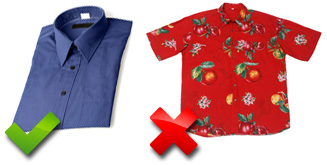
- Your shirt should be a button-down shirt with a collar. Always tuck in your shirt! Stay away from loud prints.
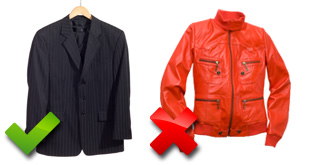
- If you’re wearing a jacket, it should be a dressy jacket, or a sports coat. Not a parka, rain coat, or casual jacket.
- Finally, your tie should accentuate your outfit, not stand out entirely. Avoid loud prints, or very bright colors.
Formal interviews for Women:
- Women should wear a pants or skirt suit with a professional shirt underneath. The shirt underneath, could be a button down shirt with a collar or another nice-looking shirt. You should avoid loud prints.
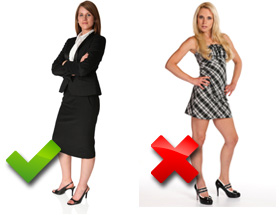
- If you do not own a suit, you should wear nice pants or a skirt, and a professional looking shirt.
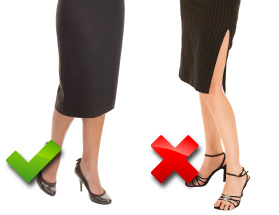
- If you choose to wear a skirt, it should be knee length, or below. Skirts above the knee may be seen as unprofessional.
- Your shirt could be a button down shirt or another nice-looking shirt. Avoid loud prints.
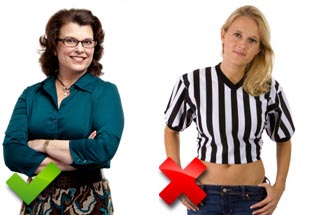
- Tuck in your shirt. If your shirt is too thick to tuck in, make sure it fully covers your stomach and back, even when you move around.
- Do this test: Reach to the ceiling. Does your stomach show? If so, your shirt is not appropriate. Now, bend over and touch your toes. Does your back show? If so, your shirt is not appropriate.
Less Formal Interviews:
While you need to look very professional for all interviews, it is okay not to wear a suit or tie to some types of interviews. These may include interviews for manual labor or retail positions, such as a cashier, landscaper, laboratory assistant, custodian, stock clerk, or veterinarian assistant. Additionally, adolescents may not be expected to wear formal attire. 
If you are unsure of what to wear to an interview, it is better to be over-dressed than under-dressed. Wear a suit, or the more formal option, if you are unsure. Or, ask a trusted family member, counselor, teacher, or job coach for their advice.
Less formal interviews for men:
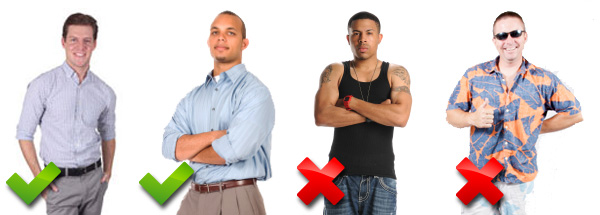
- Men should wear dress slacks (not jeans, sweatpants, or shorts) and a shirt with a collar (not a t-shirt).
- Dress slacks are usually black, khaki, brown, gray, or navy- Neutral colors. Neutral colors are generally safe and professional looking.
- Your shirt should also look professional. No Hawaiian shirts, for example! But, solids, stripes, or plaids in neutral colors are usually fine. A solid-color button-down shirt with a collar is recommended.
- Always tuck in your shirt!
- Wear long sleeves. Long sleeve shirts are generally seen as more professional for men than short-sleeve shirts.
- Wear dark colored shoes. Black or brown is safe.
- Wear matching belt and shoes (for example, if your belt is brown, wear brown shoes; if your belt is black, wear black shoes.
- Do not wear white socks. Stick with socks that match your shoes or pants- neutral colors, such as black, gray, tan, or navy.
Less formal interviews for women:
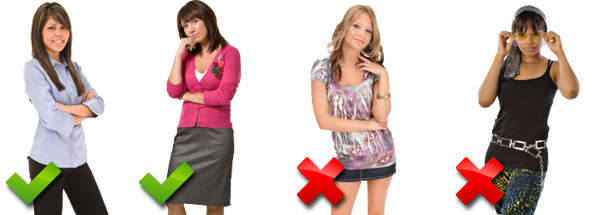
- Women are usually expected to wear a skirt or slacks and a blouse (not jeans, sweatpants, shorts, or t-shirt).
- Skirts and pants should generally be neutral colors, such as black, gray, khaki, or navy. Neutral colors are generally safe and professional looking. Women should avoid wearing shirts with loud, distracting prints, but some color is totally fine.
- Women should not wear low-cut blouses.
- Avoid sleeve-less shirts or tank tops.
- Your shirt should fully cover your stomach and back.
- Do this test: Reach to the ceiling. Does your stomach show? If so, your shirt is not appropriate. Now, bend over and touch your toes. Does your back show? If so, your shirt is not appropriate.
- Skirts should fall just above the knee or longer.
- Wear flat shoes or shoes with a low heel. Three-inch heels are not appropriate for an interview! Close-toed shoes are generally more professional than open-toed shoes. However, for some interviews, nice sandals may be appropriate.
|


 If your interview is in the morning, take a shower or bath and wash your hair either the night before or that morning.
  Be sure to brush your teeth the morning of your interview. If you eat before your interview, try to brush your teeth afterwards or eat a mint so that your breath smells fresh. Chewing gum can help for bad breath, but be sure to throw away your gum before your interview- It looks unprofessional to chew gum during an interview.
  If your hair (or beard) is long, wild, or it has been a long time since your last haircut, get a haircut a day or two before the interview.
  Remember to put on deodorant, because interviews can make you a little (or a lot) nervous, which can sometimes cause people to sweat.
  If you like to wear cologne, perfume, or scented lotion, put on just a very small amount, in case the interviewer is sensitive to smell. Less is always better!
 Men should shave on the day of the interview.
 Fingernails should be neatly trimmed and clean.
  Fingernails should not be painted in loud or very noticeable colors, such as orange or fancy prints. You want to stand out because of your skills, intelligence, and personality-- not poor fashion and grooming choices!
 Similarly, keep your hair natural-looking for the same reason. Loud hair colors can be distracting.